Tuesday, December 13, 2011

HAIR TODAY, GONE TOMORROW: FAUX HAIR FOR STAGE WEAR


Synthetic hair can change your performance look in the blink of an eye, and you definitely don’t need to break the bank by investing in a few pieces.


We are so lucky to have a smorgasbord of wigs, falls, fantasy hair pieces, faux- dreadlocks and extensions available to us!


Hairpieces made of human hair are expensive, and are certainly worth it, if you can afford them. But if you can’t, synthetic hair is the way to go. If you are wearing faux hair on stage, and it won’t be seen up close, look for super cheap deals at wig stores and beauty supply shops, as well as swap meets and on the Internet.


There are so many inexpensive and believable…or completely, fabulously fantastic on-purpose- fake-looking hair pieces around that you pretty much owe it to yourself to experiment with them. We’re talking white-blonde finger-waved 1920’s bobs, pastel pink page boy flips, luxuriously long mermaid hair, falls with highlights and lowlights, and rainbow fantasy braids, among many, many other styles.


There is something for everyone- beyond your wildest dreams. Get thee to a wig store and spend an afternoon trying on different looks!


If you are wearing a wig with a full cap, the best way to keep it stable on your head is to make small pin curls in your own hair, pin them down with bobby pins, and then weave larger bobby pins through the lace of the wig cap and into the curls in your own hair.


Falls attach onto the head in many ways. There are some that are half-wigs with combs that hook into the hair, and ponytail falls that have a drawstring which gets tightened around your own hair. Some falls come mounted on a banana-clip.


If you have a lot of hair, but want to use a ponytail fall, use this trick…that I most probably didn’t invent, but am giving myself the credit for it, anyway! Pull your hair up into a tight bun on the crown of your head, towards the back. Secure it well with bobby pins then put the fall over the bun you’ve made in your own hair. This will give a really awesome bouffant Sixties-type look, like Sharon Tate wore in “Valley Of The Dolls” or like a James Bond Girl It will give the appearance that you teased an sprayed your hair for a cool retro ‘do, but without doing any damage to your own tresses.


Dreads and braids can also be clipped in by claw-clamps or sewn on to elastics that fit around your own hair. These days they even have fake bangs that clip in to the hair above the forehead!


Whatever kind of faux hair you use, make sure you really anchor it to your head, and definitely rehearse with it to make sure it’s stable and “stage-proof”.


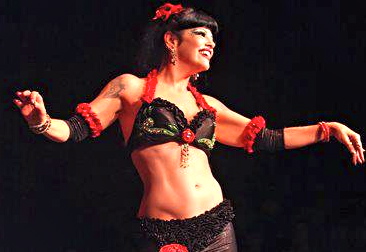
Photo: Princess Farhana as "Belly Parton" fooling around at the end of a photo session with Dusti Cunningham

Tuesday, December 6, 2011

BODY CONTOURING 101: SHADOWS AND HIGHLIGHTS


You contour and highlight your face to accentuate your features before you go onstage to make them stand out or recede.

For dancers,especially when wearing costumes that show a lot of skin, the same techniques can be applied to the body, to accentuate your muscles and curves.

It’s a pretty simple process: whatever body part is lighter will stand out, and those that are darker will recede.

With a full, fluffy brush, apply a thin stripe of pearly white, pinkish bronze or golden highlighting powder down the center of the arms and legs to make them look longer. While you’re at it, dust some of the same powder around the curves of your shoulders,and lightly across the tops of the breasts to make them appear fuller and more prominent.

Shading and contouring is just as easy. For this, you will want to use a matte color. Stay away from pearly or frosty cosmetics, because they attract light, and you will be using your contouring colors on areas which you want to appear to be shadowed.

Use a slightly smaller brush than the one you used for highlighting to dust on a darker contouring shade to the places you want to recede. A rosy brick tone or bronze color that is a shade or two darker than your own skin usually works well for people with fair to olive skin, but using matte brown colors will appear muddy on fair to olive skin. If your skin is darker, don’t be afraid to use deeper, richer browns, but make sure to keep the contour color just a couple of shades darker than your own skin tone.

Drawing a soft, smudged line in the center of your cleavage will accentuate it and make it seem deeper. Make sure the actual line isn’t visible- blend it well.

For the torso, softly brush the contour color you’ve selected onto all the spots that you want to underscore and shadow, giving the impression of more muscle tone.

Royal Secret Alert: since I do a lot of abdominal work when I belly dance and want to accentuate it, I do this all the time!

Using my contour color, I start by drawing a thin, faint line down the center of my abdomen from the cleavage to my navel, along my abdominus rectus, the long muscle that runs the length of the torso. Then I draw two more vertical lines, one on each side of the muscle.

I suck my breath in hard, look in the mirror, and brush soft contouring color into the hollows that have formed under my top ribs. I start near the center of my bra, and shade the color out towards the sides. After that, I brush on diagonal lines up the inside crest of my hipbones, pointing outwards to accentuate the cut in my obliques to make them seem more defined.

Without blending the contouring color, it will look like you have a long diamond shape drawn on your torso, with three lines up the center, dividing it. Once you blend the darker shade in and soften it up a little, brush a little translucent powder over the whole area to blend it even more. Believe me, it’ll look like you have fantastic abdominal muscle definition, especially in a dark restaurant or on a bright stage.

When I use this trick, people in the audience always comment on how ripped my torso looks…but then, those same people also tell me I have gigantic eyes, too!

All make up–but especially stage make up-is an illusion…so why limit the beautiful fantasy to your face?


PHOTO: Princess Farhana at the Las Vegas Belly Dance Intensive, 2011 by Taboo Media

Costume by Princess Farhana For King Of The Nile
http://www.kingofthenile.com/products.asp?cat=Princess+Farhana+Costumes

Sunday, December 4, 2011

MERRY MAGPIE CHRISTMAS!


My entire house looks like a really messy backstage, it’s full of costumes and headdresses, swords, opera-length gloves, feather fans, Isis Wings, silk veils, fan veils, glitzy ballroom shoes, you name it.

That on it’s own wouldn’t be a big problem, except for the fact that my closets, shelves, and drawers are loaded down with yards of shiny materials and sequin trims, beads, rhinestones, bugle bead fringe, loose feathers and coins… not to mention broken jewelry, scraps of lace, hunks of rayon chainette fringe, a random foot of 4” wide organza ribbon, mis-matched drapery tassels, random buttons and Mardi Gras beads.

Yep, I’m a magpie, attracted to bright and shiny objects...which I take back to my "nest" on a regular basis!

Every so often, I have a kooky fantasy that the television show “Hoarders” will call me to offer me a starring role in an exclusive dance-centric episode, but so far…that hasn’t happened.


But I like to recycle and re-purpose these things-every day objects- into costumes, props and accessories. So instead of holding onto all this dazzling stuff, I like to make Christmas stockings for all of the kids ( and adult kids) in my life: my nieces and nephews; my dancer and civilian pals and their kids, too.

Some of my friends call me “The Showgirl Martha Stewart”, but I wasn’t the originator of these stockings.

This holiday tradition started with my Grandma Nelly, who was an ardent crafter; she fashioned beautiful sparkly felt stockings by hand for all her grandchildren. My mother continued this lovely custom, and every year I get out the blue Christmas stocking she so lovingly made for me, marveling that the little evergreen tree still has every pearl and sequin “ornament” intact!

I love carrying on this magical legacy, and you can do it too- because they’re so easy, and lots of fun to make!

First, have a look through your craft supplies, and see what you have- pretty much anything sparkly, shiny or bling-blingy will do. Make sure you have a needles and thread, craft glue and a glue gun on hand, too.

Gather all your bits and pieces together, then start thinking about which you’re going to make your stockings for, picking out a design that will delight your recipient. Sketch out your idea, and then start figuring out which leftovers will work best for your stocking(s).

I created all the stockings pictured here, and had a blast doing it. The peacock stocking was for one of my sisters, cause she was really into peacocks- and silhouettes. And of course, the person who got the Obama stocking was obsessive about our president! Ho-Ho-Hope! The pink stocking with the Egyptian motif was for the baby daughter of my dear friend Bahaia, the Texas-based belly dancer; the pink stocking with the horse on it was made for my niece who loves to ride, and the kitty was for my boyfriend, who calls himself “Mr. Crazy Cat Lady”!

After you’ve gotten your design together, cut out a large, simple stocking shape from a double thickness of felt, using a pinking shears or even just a regular scissors- the felt won’t ravel. My Grandma Nelly probably started off using felt because it doesn’t have to be hemmed…it’s also inexpensive and quite durable.

I make my stockings about 12” wide at the top, and about 15”-18” long at the bottom, where the foot shape is. They hang about 17"-20” long. With these measurements, you can actually fit little stocking stuffer presents inside the stocking before you give it as a gift.

Next, lay out your design on the felt, pin it down, and hand-sew ( or glue) the embellishments to the felt. Since I’m a confirmed glitter addict, after I’ve done this step I glue tons of rhinestones on top of all the designs!

Add any trimming you like to the top- wide ribbon, thick braid or sequin trim is always good to use, and those leftover pieces of fringe work very well here- attach the fringe, then put the trimming over it.

With embroidery thread or dental floss, hand stitch the stocking sides and bottom closed.

Last, sew on a looped length of pearls-by-the-yard or a doubled tab of ribbon to one of the corners at the top, attaching it on the inside. This way the stocking can be hung on the mantle... with care, of course.


If your hand sewing skills aren’t that great, you can machine stitch the stocking around the edges if the decorations aren’t too close to the borders. Or, if you just don’t have the time to make the stocking shape, just buy an inexpensive plain stocking- there are scads of them everywhere- and then custom decorate it.

Last: when you leave out cookies and milk for Santa, make sure to add in a pair of sunglasses for him, because if you’ve made the stockings in true showgirl style, they’re gonna be so bright, he’ll need shades!

Thursday, December 1, 2011

HOLIDAY DAZZLE...A FEW WORDS ABOUT GLITTER


Ah,glitter! Where would we dancers be without it? No doubt you've seen this before:

"Glitter Is The Herpes Of The Art World"


...I'm not sure who originally said this, but like Herpes, glitter is certainly "the gift that keeps on giving"-it gets all over everything, and stays embedded no matter how much you try to get rid of it. It sticks to you, your significant other, your pets, your furniture. In fact, I don't even think comparing it to Herpes drives home the point of how much glitter pollutes....everything it gets near.

I prefer this saying,which i made up myself:

"Glitter Has More Of A Half-Life Than Uranium!"


What was once the sole domain of pre-teens and strippers, glitter is now a performance mainstay for all types of dancers...as well as gymnasts, cheerleaders and gals who like to sparkle on the dance floor during a night on the town.

And now that the Holidays are upon us, glitter is EVERYWHERE
.

Glitter looks lovely under stage lights, it will highlight your every movement and make you look like a fairy dusted fantasy. It can be applied to the skin , and even on top of the stockings on your legs - or body stockings, if you wear them. There are many types of commercial body glitters available;they come in sprays, oils, and in little solid waxy bars as well as in the “sprinkle on” type. However, I prefer to make my own body glitter mix; it looks much better with my coloring, and it also saves money!

On your face and especially around your eyes, you must wear cosmetic glitter. In the old days glitter was made of metal flakes. Now, glitter is usually made of some type of copolymer plastic. The individual cosmetic glitter flakes are laser cut, in shapes that are are oval and/or rounded, not square or octagonal the way most craft glitter is cut. When used on your face, this will reduce (but not prevent!) any injury, should the glitter get into your eyes. Also, some craft glitter is still made of metal.

How do I know this? I am so glitter-obsessed that I actually have a friend who was a biology student at Berkeley look at many types of body glitter, craft glitter and cosmetic grade glitter under her microscope! I sent her lots of unlabeled glitter samples, and she told me what shape they were and what they were made of…it was extremely educational!

But back to making your own body glitter and saving money by doing it- since you will not risk potential injury by using craft glitter on your body, there is no need for you to buy expensive, pre-made body glitter.

Buy a few different colors of regular, inexpensive craft glitter, the kind in the big shakers, then mix them up in a jar and pop it into your gig bag, along with a small container of hand lotion or body cream. When you want to glitter up, just mix the two products in the palm of your hand and apply it liberally to your skin.

For my own body glitter mix, since I am fair-skinned, I use equal parts of lavender, opalescent pink, iridescent white, gold and silver. If you have skin that is darker, you might want to also mix in shades of bronze, orange, opalescent yellow and copper.

Deeper colors of glitter such as dark reds, purples, black, blues or greens tend to look ashy and strange onstage, so stick to a mix of shades that enhance your natural skin tone.

Insane as this may sound, I also think glitter is a great exfoliant! When you wash it off in the shower, it totally helps to slough off any rough or dead skin cells.

A word to the wise: though glitter looks great in motion ( such as in performance, on film or videotape) but in still photos, but it can appear gritty and make your skin look bumpy, unless you are photographed from very close up, so think about doing some promo shots without it, then adding on the sparkles... or just saving it for performances.

Oh, and be prepared to sleep in a bed full of pixie dust, because that’s exactly what you’ll be doing post-show, even if you showered the moment you got home!

I’ll say it one more time: do not use craft glitter on your face!

Now get on out there and SPARKLE!


#


To get a Tarot card reading from me or to check out what I do when I’m not dancing, click here: http://www.pleasantgehman.com/


Sunday, November 27, 2011

DANCERS BACKSTAGE RITUALS PART SIX: ARTEMIS MOURAT AND TAMALYN DALLAL


This is part six in an on-going series of articles about the ways that well known- and in some cases, wildly famous- dancers prepare for their shows. Everyone I have spoken with has a highly personal take on getting ready for taking the stage, but one similar thing I've noticed while talking to my colleagues is that many of us seem to be very spiritual in general, and especially in relation to their dance practice.

For years, I assumed I was alone in this… but that was probably just because I just hadn’t discussed my feelings with anybody.

From the very beginning of my career, I would always become very emotional before I took the stage- and by using the word "emotional", I'm not referring to stage fright. It was more like a private, internal feeling that I would get just before I stepped onto the stage. Waves of gratitude and even disbelief would overwhelm me. Though I knew I had worked very hard for years to get to the point I was at, I would be overcome by a sense of my own good fortune and I felt humbled that I was being allowed to live out my dreams.

I have always been blessed with creativity, and I have always wanted to dance, but for me, dancing wasn’t always an easy journey. From my first performance onwards, every time I was about to dance, I would thank the universe and the heavens for being allowed this chance, and I would silently pray that that my performance would be “worthy”, both for the audience, and for whatever spiritual forces were granting me this beautiful opportunity. And I still do.

The two dancers- Artemis Mourat and Tamalyn Dallal- whose quotes you will see below, both seem to feel that in their dancing, they are connecting with a very sacred thing, in very much the same way as I do. In an odd coincidence, both of them are also writers and globe trotters as well as dancers, just like me.

Since we are in the midst of The Holidays, I thought it would be a good time to put up a post that is a bit infused with the spiritual side of dance.

Also, as I write this, I have just gotten off the phone with the highly acclaimed Artemis Mourat. She is a lovely person both on and off stage, quite down to eath and extremely funny. Our conversation was all about dance, history and culture, but of course we giggled a lot, too!

A legend in her own time, a belly dance pioneer and an expert on Turkish and Romany dances, Artemis is practically a household word in the belly dance community. She has done decades of field research all over the globe. She has also performed and taught worldwide, made music CDs and instructional DVDs, and has always been extremely generous with her wide scope of knowledge. To say that she has inspired thousands of dancers during the course of her rich career would be a vast understatement!

Here are Artemis’ words:

I pray before each show. I ask that light shine through me onto all who see me. I asked that everybody there leave the show happier than they were when they got there. I ask to be worthy to carry this torch. I ask that the blood of the dancers who have come before me should flow through my veins. And I ask for a spiritual wall of protection around me and around all of the people there.
In addition to this, I do the usual physical warm ups and one glass of wine is mighty nice.
--ARTEMIS MOURAT


Tamalyn Dallal performed and taught around the world since 1976. In addition to being a superlative dancer, has authored three books, including her latest “40 days And 1,001 Nights”, where she lived for forty days in five Muslim countries, and recorded her experiences. Not only that, she produced a documentary film and two music CDs, both based on the book! In 1990 she founded the Mid Eastern Dance Exchange, which mentored dancers all over the globe. The last time I bumped into Tamalyn, it was this past June in Cairo. I haven’t spoken to her lately, but I know she id doing a continuing documentary series called "Dance On Film" and Ethiopia is next. Here is a link to her Kickstarter site to fund the project:
http://www.kickstarter.com/projects/1758509566/dance-on-film-series-ethiopia-is-next/backers

And here is Tamalyn’s pre-performance ritual:

I usually say a prayer and consider how lucky I am to be able to dance, free to dance, and live in a place where women have the luxury of taking a dance class. So many places, people have hard lives and struggle to eke out a living and feed their families.
We are among the privileged few who can dance our hearts out in beautiful costumes for the sheer joy of it. I then think of my dance being offered to the audience as a gift.
--TAMALYN DALLAL


To read more about these infinitely inspirational dancers, please visit their websites:
Artemis Mourat: http://www.serpentine.org/artemis/artemis.htm

Tamalyn Dallal: http://www.tamalyndallal.net/homepage.html


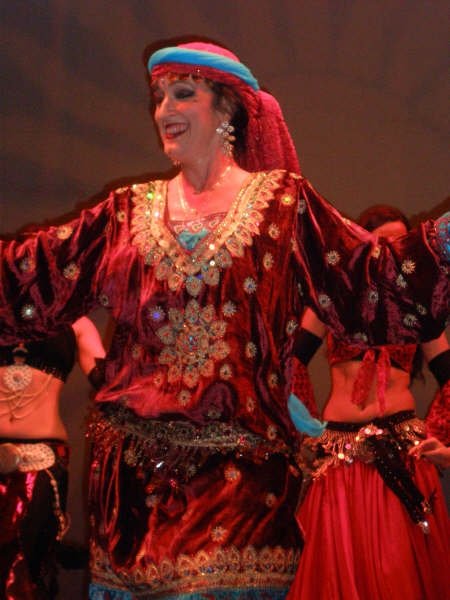
Photos: Artemis ( in black) & Tamalyn ( with headwrap)

Thursday, November 24, 2011

DANCE PARTNERS


It’s Thanksgiving, and I would like to take this moment to thank all of the “dance partners” out there…all the spouses, significant others and close friends who make it possible for all of us performers to be able to do what we do.

As an entertainer, having a supportive partner is paramount. Our partners are like The Great Oz, they’re the people behind the curtain…and behind the scenes, backstage, schlepping our bags, building our props, taking photos, taking us to the airport at ridiculously early hours as we leave for workshop weekends…. and picking us up when we come back, sore and hoarse and full of stories about people they don’t know.

Our dance partners are the ones driving back to get the costume piece that was left out of the gig-bag, the ones dee-jaying or sitting at the door taking tickets at the hafla, they are the stage managers and lipstick roadies, and the ones who tell us we are lovely when all the make up is off.

Our dance partners are the ones who allow us to rope them into burning cd's, being emcees, or doing something crazy in costume as part of our shows…cause nobody else would do it! They’re the people who bring us food in class when we are starving, who send us “Break a leg!” texts when we are backstage at shows they couldn’t attend.

Our dance partners are the men and women who make our websites, and make us coffee when we have early classes to teach. They’re the “civilians” who know (by osmosis) how to layer complicated moves, the ones who surprise you by knowing the difference between Egyptian and Turkish music, or classic and neo-burlesque. They're the caretakers who know when you need ice and ibuprophen, and they rub your sore muscles when you're in pain. Our dance partners are already in bed by the time we get home from gigs, but they don't mind that we came home so late. They are the ones who don't get to see us very often, but they never complain.


They are the patient souls who don’t grumble when they have to go to work covered in your body glitter, or the odd rhinestone… but wear the sparkles proudly, because they are so happy to be with a dancer, that they want the world to know!

This is for all the belly dance widowers, the burlesque husbands, and the supportive best friends who never so much as took a dance lesson but come to all the shows…thank you all so much- we couldn’t do it without you!


Photo: The Princess and her favorite dance partner, james

Tuesday, November 15, 2011

BELLY DANCE BODY ADORNMENT


Something all belly dancers have in common is a love of body adornment. We pile on make up, jewelry, wigs, hair decorations, costumes and permanent or temporary tattoos until we look like human Christmas trees, or a prize doll that you’d win at a carnival!

Many of the cosmetics and accoutrements we use are modern inventions, and worn just for fun, such as body glitter…but a lot of the adornments we wear come from customs that are probably older than recorded history.

Here are some types of body decorations that have been traditionally linked specifically to belly dance or to cultural, religious and ceremonial traditions that have been adopted by modern-day belly dancers:

Kohl
Probably the world’s first and most famous eyeliner, kohl has been used constantly from ancient times to the present day. Thousands of years ago in Egypt, the luxurious fine black powder rimmed the eyes of women, as well as men and children, and acted not only as a cosmetic, but served to protect the eyes from the glare of the hot desert sun, and was also known for it’s antibacterial properties. Ancient Egyptian art included depictions of both humans and gods alike with heavily rimmed dark eyes.

Desert nomads, as well as city dwellers still use kohl today for these same reasons. For centuries, kohl was made from ground up minerals, such as antimony and galena- or ash- mixed with animal fat and/or some sort of oil. Galena and antimony,which are both lead sulfide products, are toxic and their use can lead to lead poisoning; also, kohl made with any sort of ash or charcoal in it is a carcinogen.

Kohl is still widely used throughout North Africa as well as in the Middle East, where it is sometimes called kajal and in India, Pakistan and other Asian countries where is known as surma.

Nowadays, traditionally-made kohl is widely available in it’s countries of origin, but because the manufacturing of kohl is mostly unregulated, not to mention the potential danger of the ingredients, importing it is illegal in many Western countries.

Commercially packaged kohl is often for sale at bazaars, import or specialty stores, but remember that you will be putting this product on your eyes, and you may not be sure exactly what is in it. You can get the same exotic effect from using any number of commercially manufactured, safe-to-use soft eye pencils or powders.

Henna
Since the dawn of history, henna has been used as a cosmetic. In ancient Egypt, Nerfertiti and Cleopatra were known to use henna, and it was also popular in India and throughout the Roman Empire. A shrub that is native to arid climates, henna was cultivated for many uses. The leaves were ground into a paste, sometimes referred to as mehndi, that was coveted for the rich reddish-brown color it produced. Mehndi paste been used for thousands of years to dye hair, skin, fingernails, fabric, and leather, such as saddles and drum heads. The flowers of the henna plant were also used to make perfume. Additionally, henna has medicinal properties, and has been used for hundreds of years as an antifungal agent and insect repellent.

In the ancient Middle East, North Africa and Central Asia, henna was regarded as bringing baraka or blessings to those who wore it. Henna was used in bridal ceremonies on the bride herself often in intricate, traditional designs, as well as on the groom and on the wedding guests. It has also been traditionally used in other celebrations such as circumcisions, the Hebrew festival of Purim, or in Arabic countries for Eid parties or Islamic moulids, or saint’s days. These traditions that have continued for centuries and show no signs of going away.

On these types of occasions, henna is applied to the hands and feet (and sometimes other places on the body) in intricate, traditional designs, which are supposed to ward off evil and bring good luck to the person wearing them. Often, henna paste or mehndi was also applied to the hooves and tails of domestic animals, such as donkies, horses and camels, for the same reason.

Depending on the strength of the paste, and the texture of the person's skin to which it is applied as a tattoo, henna decorations can last anywhere from a few days to a few weeks. After drying, it can appear in any shade ranging from bright orange to dark brown. These traditional designs are applied with a wooden stick, or squeezed from a cone, and done free hand or sometimes with mehndi stencils.

Bridal mehndi has become a booming business in modern India, Pakistan, and many Arab countries, as well as in immigrant communities in North America and Europe. This work uses contemporary as well as traditional designs, and often incorporates glitter, rhinestones or other modern touches.

Henna has also taken off as a trendy body decoration among people who have no idea about its cultural or historical significance. It is often offered as temporary tattoos at Renaissance Faires, street festivals and pirate gatherings or bachelorette parties. Another place henna is commonly seen is at beach resorts, where street vendors offer henna as temporary tattoos.

Often artists offer “black henna”…but word to the wise: in nature, there is no such thing as black henna. The paste used to create the jet-black henna tattoos usually is mixed with a carcinogenic hair dye containing para-phenylenediamin, or PPD. When applied directly to the skin, PPD can cause extremely severe- and in some cases fatal- allergic reactions in certain individuals, including blistering, permanent scarring and long-lasting chemical sensitivity.

Make sure than any henna product that you put on your skin or hair is made of all natural ingredients.

Tattoos
Throughout the Middle East and North Africa, tattooing has been practiced for centuries. The discovery of mummified remains from ancient Egypt seems to indicate that tattooing was fairly common in those days. More recently, Egyptian Coptic Christians had crosses tattooed on their wrists, and occasionally on the forehead, to distinguish them from Muslims.

Within Berber and Arab tribes, many women typically bore facial tattoos, with mystical designs that were meant to accentuate beauty, ward off the Evil Eye, prevent disease and prolong life. Many Berber women had tattooed chins, with a series of lines and dots extending from directly below the lower lip, the purpose of which was to increase fertility. These tattoos were usually applied around the onset of puberty, on nubile women who were ready for marriage. Tattoos on the cheeks and temples were also traditional. Bedouin women were often heavily tattooed as well, usually by the Nawar, a nomadic people who roamed through Egypt, Libya, Iran, Iraq and Syria and other territories until the beginning of the last century. The tattoos were applied by hand, with ink that was composed of a paste of ashes, water, plant sap, and sometimes mother’s milk.

Often, belly dancers performing folkloric dances from North Africa and Middle East will paint on these traditional facial tattoos with eyeliner, to create an authentic look.

During the 1960’s and 1970’s, many Turkish belly dancers sported tattoos of a five-pointed star, usually on the calf or thigh. I am not sure about the origin or tradition of this, but I have seen this on several vintage promotional pictures of Turkish dancers from the time period.

Currently in America and Europe, many belly dancers have beautiful-and quite extensive -tattoos. This was pretty rare in the global belly dance community until fairly recently, because dancers working at Arab clubs and restaurants didn’t want to offend the owners oor clientele, many of whom were Muslim... and tattooing is forbidden in the Muslim faith.
However, tattooing became more accepted and downright trendy among the general public around the same time that Tribal style was making a mark on the belly dance community. Henceforth, there are many dancers around the world sporting a lot of beautiful ink!

Bindis
A bindi is an adornment worn on the forehead, generally seen in India, Sri Lanka, Bangladesh and other South Asian countries, where they are sometimes called kum kum. The word “bindi” comes from the Sanskrit word bindu, meaning “dot” or “drop”. Bindis are traditionally placed between the eyebrows, at the sixth chakra , and are sometimes referred to as the “third eye”. Contrary to popular belief, the bindi does not denote wedlock, and is not worn only by Hindu women, nor does it signify age, social status, religious background, ethnicity or sex: bindis can be worn by men, women or children. When worn by men (usually as a sign of devotion) the mark is referred to as tilak.

Traditional bindis were often red, and applied with a moistened powder. They were thought to have many meanings, including aiding the wearer in focus during meditation, and as a sign of beauty.

In modern times, some bindis are still applied the traditional way, but sticker bindis have become hugely popular, with the self-adhesive decorations coming in a wide variety of shapes and sizes. Some are so intricately made, they are tiny works of art, including foil, rhinestones, twisted wires, and colored beads. A modern take on these decorations are "intimate bindis"- jeweled stickers designed to fit around a woman's private parts and nipples!

Even though bindis are not traditional in Arabic cultures, because of their exotic beauty, not to mention their bling-bling factor, in the past decade or so they have been all the rage with belly dancers of all styles, who wear them purely for ornamentation.


Head And Hair Decorations

The beautiful traditional Indian jewelry called maang tikka are hanging ornaments meant to be worn on the forehead or in front of the ears. Popular for centuries with Indian brides (and for quite some time with belly dancers) the tikka or decoration, hangs from the maang- a string or chain that fits across the crown of the head, and ends with a hook that attaches into the hair. Maang tikka are made from any number of precious and semi-precious metals and stones, and are also reproduced as costume jewelry. The forehead tikka is designed to hang at the sixth chakra, whichis an important are according to Ayurvedic beliefs.

Many Orientalist paintings as well as racy antique photo post cards depict odalisques or harem slaves with thick braids in their hair, adorned with strings of pearls, coins and tassels. Documented in photographs from the early Twentieth century, the Algerian Ouled Nail dancers embellished their braided hair with all sorts of beautiful ornaments, from heavy strings of silver coins to jewel-encrusted diadems, or crowns. Crowns and tiaras are also worn as part of traditional costuming for Uzbek and Persian dances, often with trailing veils. From the Ottoman era to the mid-twentieth century, Turkish dancers often wore small pillbox-style hats, frequently decorated with metallic braiding, pearls, jewels or strings of beads.

Belly dancers often wear fresh or faux flowers in their hair, though it is unclear whether or not there was traditional significance in Arabic or Middle Eastern cultures, other than decoration. Across the world, in a kaleidoscope of cultures, women have always worn flowers in their hair. In general, the flowers served a dual purpose for the woman who wore them- they were not only a beautiful decoration, but they gave her a pleasing scent. Flamenco dancers typically bedeck their hair with fresh-cut roses or other flowers. In Tahiti, dancers wear crowns of flowers called hei, as do brides and grooms on their wedding day. In Tahiti and Hawaii, a single gardenia blossom worn behind a woman’s ear also means something: worn on the right side, she is available; worn on the left, she is spoken for. Japanese Geisha typically wear kanzashi, or silk hair ornaments fashioned into plum or cherry blossoms, attached to the hair with combs. Many Indian women wear long, fragrant strings of fresh blossoms in their hair, or attached to the ends of braids.

Today, many Tribal and Fusion style dancers often wear entire “hair gardens” with fanciful flowers decorated with rhinestones, strings of coins, pearls, cowrie shells and feathers. Faux flowers, crowns and tiaras have always been popular with cabaret style dancers, too.

Piercings
Piercings have been a widespread body modification in various cultures for centuries, with the most common placement being the earlobes and the nose. Historically, many African tribes also pierced the lips and tongue, and nipple and genital piercings have been traced by to Rome and ancient India, respectively.

Pierced ears on both men and women were prevalent in ancient Greece and Persia, and one has only to look at the gold death masks of King Tutankhamen and other Egyptian Pharaohs to see that this practice was popular in ancient Egypt!

Pierced noses have generally more commonly seen on women, from many different countries. In India, many women had the left side of their nose pierced, because Ayurvedic medicine associates this area with the female reproductive system, and it was assumed this would aid in child bearing. Nose piercings in India were considered a sign of physical beauty and also to honor the Hindu goddess Parvati, who is associated with marriage. In Central Asia, many Pahari and Pashtun women have both nostrils pierced with rings, allegedly to pay for their funerals.

More recently, in Western cultures piercing is a popular trend, with no special social significance attached. Earlobes and nostrils often sport multiple piercings, and areas such as the navel, nipples, eyebrows, genitals and lips are fashionable as well as socially accepted piercing locations.

Bracelets
Bracelets have been worn by women of all cultures for many millennia. In ancient Egypt men and women wore scarab bracelets, which symbolized rebirth, and were also affixed to the arms of mummies for the afterlife.

In India, bangle bracelets are common, and in some parts of the country, the number and type of bangles denotes marital status. Bulgarian women traditionally tied red and white string bracelets, or Martenitsa, to their arms in the early spring as an offering to Baba Marta, a mythical old woman whose moods controlled the weather. A similar tradition is found in neighboring Greece, where women weave string bracelets and wear them from the first day of March until the last days of summer.

Gypsies and fortunetellers are often depicted wearing piles of bracelets, perhaps stemming from the Indian-Romany connection. In certain styles of Uzbek dance, performers wear bracelets of small bells to accent their intricate hand and arm movements.

Belly dancers often wear bracelets just because they are pretty, and many Egyptian and Turkish costumes come with accessories in the form of bracelets, arm cuffs, gauntlets and armbands.

Anklets
Historically, ankle bracelets were worn customarily by women and girls in India as well as across the Middle East and North Africa. Nomadic tribes such as the Rom or Romany, Berber and Bedouin females often sported them, too. Anklets were worn for decoration, but also for cultural or religious reasons as well. In the harems of Turkey, anklets with a chain connecting from leg to leg were worn by female odalisques or slaves, for the purpose of creating a more “feminine” gait.

Anklets were also common in societies that practiced segregation among the sexes, such as in India, where anklets were worn during times of Purdah. Called payaal or jhanjhar in India, the anklets were often made of chains hung with small bells.

In the zambra mora, a style considered by many to be the missing link between Romany dance and Flamenco, barefoot dancers often wear ankle bells to accentuate the stomping and intricate, rhythmic foot patterns that are a part of the dance.

In Egypt, up to the middle of the Twentieth century, women frequently wore -and sometimes still wear- khukal, which are the traditional C-shaped, open-ended ankle bracelets hung with coins or small metal discs. There is even a famous Egyptian musical composition called “Rennat Al Khukhal” or “The Sound Of Ankle Bracelets” which often used as a song to belly dance to.

many of these types of anklets do make beautiful tinkling sounds when worn while walking, but the real purpose of ankle bracelets was probably to let everyone know that a woman was approaching.

Nowadays, ankle bracelets are worn by dancers for both traditional as well as purely decorative purposes.

Photos:

Vintage photo of an Ouled Nail dancer with headress and facial tattoos

Belly dancer Luna with bindi and Tribal Fusion head decorations , shot by Princess Farhana

hands with traditional mehndi pattern and bangle bracelets

Indian bride wearing maang tikka and many bangle bracelets