Showing posts with label Artemis Mourat. Show all posts

Monday, July 16, 2012

ZILL-TASTIC: MAKING FRIENDS WITH YOUR FINGER CYMBALS


Finger cymbals might as well be the international symbol for belly dancing.

Cymbals and veils are usually what civilians imagine when they think of belly dance. Known as zills in Turkish, sagat in Egyptian Arabic and salahsi or zang in Farsi, many dancers assume cymbals are a prop, but they’re actually a musical instrument.

Cymbals make a variety of sounds, depending on how they’re played, ranging from bell-like ringing with an audible sustain to clicks, muffled claps, and quick-strike chunky tones. The pitch of the cymbal itself differs considerably, depending on the construction; the metal alloy (usually brass or bronze) the circumference or diameter of the cymbal, and the depth of the rounded dome that rises up from the cymbal’s rim. Finger cymbals are manufactured in a wide variety of sizes, weights and finishes, many with beautiful Pharonic or Arabesque designs stamped or cast on the metal.

There are four cymbals in a complete set, worn at or just above the first knuckle of the thumb and middle finger on each hand, attached with an elastic loop. Some cymbals have a hole to thread the elastic through, others have two slots. Often, dancers have a preference for the type with the slots; because they are easier to control- I much prefer this type myself. I used to think the cymbals with a single hole were just mediocre souvenirs, and that only a beginner would even think of using them. They kind of dangle off the fingers, instead of sitting firmly on the underside. Then I bought a gigantic set of cymbals in Cairo, the type that are used in Egyptian orchestras…and that set only had the single hole! Years later, Artemis Mourat set me straight, explaining that both types of cymbals were “legit”, and used traditionally.

Playing cymbals used to be practically mandatory for belly dancers (hence the public’s association) but in the early ‘90’s, when Egyptian style became popular in the west, performers hoping to appear “authentic” hung up their cymbals because Egyptian dancers rarely used them. What most didn’t realize was that the real reason Egyptian dancers didn’t play was because they didn’t have to! In Cairo, professional performers work with large orchestras that always include a master sagat player. I was guilty of this misconception myself, and in the midst of my early studies, blithely informed my first teacher Zahra Zuhair, that I wasn’t going to play cymbals because it wasn’t Egyptian. She looked disappointed, so I added,

You dance Egyptian style, and you don’t use cymbals!”

She regarded me for a moment, then arched a well -groomed eyebrow and said,

“Well, the difference between me and you is…I can play them if I want to!”

Point taken.

I began the lengthy and often frustrating process of learning cymbals, but in the end, I was so glad that I did! Finger cymbals aren’t required for belly dance, but if you can really rock (or shall we say “raq”?) On them, they add a lot to a performance. Cymbals played in flawless unison by a troupe is really powerful; a solo dancer accenting her music artfully or doing playful call and response with a live drummer is always really exciting for an audience! If you perform often using recorded music, playing cymbals adds that special live energy.


Here are some tips that will help you become a zill-tastic dancer:

Cymbal Selection And Preparation

To start off with, you should purchase a set of good quality cymbals that will be easy for you to handle. For beginners, it’s usually better to get a smaller, lighter set of cymbals until you build up your strength and co-ordination, though starting with lager cymbals is fine. No matter what the size of the cymbals, they’ll always seem awkward at first…when I first started, I felt like I had a dinner plate attached to each hand!

Look for a set with a nice tone; if you’re shopping in person, you’ll be able to test them out and see which ones you prefer. If you’ll be getting your cymbals online, there’s no way you’ll be able to test-drive them, so ask your instructor or dancers who’ve been playing for a while which type they recommend.

Listening to dancers playing sagat live will not only help you to absorb the patterns being played, but to figure out which tones you like as well- and it’s all a matter of personal taste. I prefer a mellow bell-like tone, and like my cymbals to ring, but when I asked master musician and dancer Karim Nagi about his preferences he said,

I would select something a little heavier that one could get good contrasting sounds from, anywhere from deep tones and to high crisp tones. Just like any instrument, chances are you would have to try a few out. Personally I would select something a little heavier- if a set of cymbals sound too bell-like, and I can’t get that chunky, tight sound that I like, I won’t use them.”


Preparing And Caring For Your Cymbals

Some cymbals come with a length of elastic, but if it isn’t supplied, you’ll have to buy it. Look for sturdy elastic braid about three quarters of an inch wide for the type with two slots. If you bought the single-hole cymbals, you’ll need a thin, rounded elastic cord. Next, you’ll need to sew the elastic on to fit your fingers. For the double-slot type, cut four lengths of elastic about three inches long and thread the elastic through the underside of the cymbals. Measure the elastic to fit your finger tightly, turn the raw edge of the elastic over to prevent fraying, and sew the pieces together. For single-hole cymbals you may want to thread the elastic cord through a bead or small button (which will sit on the underside of the cymbal) to add some extra stability. Some dancers mark the slightly larger-looped thumb cymbals by sewing a bead onto the top of elastic, and I sometimes decorate my elastics by gluing a small rhinestone to the top of each one. Yup, I like the glitz!

If your elastic breaks at a gig or in class, you can quickly repair it with a safety pin. Do not pin or knot your cymbals underneath- it ruins their sound by muffling the dome…imagine stuffing a pair of socks into a small bell and you’ll get the picture!

Finger cymbals should be worn very tightly- it’s a running joke among dancers that if you’re circulation isn’t getting cut off, they’re not tight enough! I also think the elastic on cymbals compares to the pointe shoes ballet dancers wear: they’re unbearable at first, then you get about a week of broken-in comfort, and after that it’s time to change them!

The cymbals should sit up near the top of your fingers and thumb- some dancers prefer the elastic to hit at the first knuckle, others like them just below the nail bed. When you put your cymbals on, they should worn with the underside facing each other and, as legendary dancer Helena Vlahos says,

“ They should look like a pair of flying saucers on each hand.”

Cymbals can be cleaned with a soft cloth and ordinary brass or metal polish. Some dancers prefer bright shiny cymbals, others like them to have a patina or a slight amount of tarnish, for a vintage look; this is only an aesthetic consideration and up to you, because they’ll sound the same either way.

Before You Start To Play

Experiment with some of the many tones and sounds cymbals your cymbals make. Here are some for you to try out:

Rings

The quick strike of two cymbals together, creating a lingering ring like a bell

Claps

A strike with fingers of the hand cupped over the index finger cymbal, producing a flatter sound without any ringing

Clicks

Strike only the edges of the finger cymbals together, with your fingers cupped or open to produce percussive little ticks and clicks

Double Rings

Put your hands together and strike all four cymbals together lightly against each other (almost fluttering the cymbals) with both hands open, to make a tinkling, sustained ringing sound


Practice Makes Perfect

Like any musical instrument, mastering your cymbals requires a lot of training. I myself think I bit through like...five layers of skin on my lower lip!

When you’re playing, you will always start on your dominant hand. If you’re right handed, start with the right hand, but southpaws will begin on the left hand.

Practice as much as you can so you can play your cymbals easily and switch rhythms without even thinking about it. Start off doing cymbal drills seated or standing, and then add in some basic movements. After you’ve become comfortable with that, start experimenting with more advanced technique. Eventually, you want to be able to perform quick shimmies, traveling steps, and multi-layered movements while playing. You should also be able to play cymbals with your hands and arms in any position they would be in if you were dancing without them, with palms up or down, arms outstretched, overhead, crossed or moving on paths through the air, and while doing wrist circles.

Getting to the point of playing really well (i.e. on the beat and not at the expense of your movement) will take dedication and regular practice. It can be frustrating, but it will be worth it in the end!

After you’ve mastered the basics and can dance with your cymbals on, there are many ways to play them: to the basic rhythm of the song, to the melody, or just as occasional accents. Los Angeles based Arabic percussionist Donavon Lerman says:

“ Think of your zills as a solo instrument. Just like every rhythm has a matching basic movement on the dancer’s body, every rhythm has a matching basic rhythm on the zills. They should almost never be used constantly. They ought to be mostly used to add flavor, for a solo, to accentuate the dancer’s moves, for playing back and forth between drummer and dancer.”

He continues,

“ I would kinda correlate it to a dancer practicing a shimmy… they have to do it everywhere; in line at the grocery store, while doing the dishes, while eating ice cream… but then they choose not use it too much in performance. When cymbals are used while you dance, they should be strong and in the right place.”

Karim Nagi offers this suggestion:

“Remember, zills are an instrument, and you’re adding the instrument to the song, so be selective about when to play. With live music, don’t play for the entire song. Choose when to play based on the song’s structure, and if there’s a singer, don’t play when he or she is singing the verses. Another choice is to play for the choruses only. If you play for the entire song, then you’ll be distracting from the band.”

Basic Cymbal Patterns

Here are some basic, commonly used patterns for practice. Again, because most people are right handed, these patterns all start on the right, so just reverse them if you’re a leftie.


GALLOPS OR THREES:

RLR RLR RLR RLR RLR RLR RLR

123 123 123 123 123 123 123


ALTERNATING THREES:

RLR LRL RLR LRL RLR LRL RLR LRL

123 123 123 123 123 123 123 123


THREES AND FIVES:

RLR RLRLR RLRLR RLR RLRLR RLRLR

123 12345 12345 123 12345 12345


THREES AND SEVENS:

RLR RLR RLRLRLR RLR RLR RLRLRLR

123 123 1234567 123 123 1234567


SEVENS

RLRLRLR RLRLRLR RLRLRLR RLRLRLR

1234567 1234567 1234567 1234567


Zill-Tastic Resources:

Instructional DVD from Artemis Mourat:

Zill Speak - How to Play Finger Cymbals from A(lmee) to Z(ills)


Turquoise International Finger Cymbals :

http://tinyurl.com/73flpdd


Saroyan Mastercrafts Finger Cymbals :

http://dwp.bigplanet.com/saroyan/onlinestore/

Friday, March 16, 2012

CREATING A HEALTHY DANCE COMMUNITY


Last weekend I had the pleasure of performing and teaching in the Washington, DC area. I was absolutely struck by the wonderful dance community that I witnessed... dancers of all genres getting together on a regular basis to put on shows; students learning professionalism from their "dance mammas", and performers taking the time to give back to the community.

One of the highlights of the entire great weekend was talking shop with Artemis Mourat and my sponsor, Belladonna. We sat around Artie's cozy house sipping wine and feasting on a Moroccan chicken dish she'd prepared, and talked for hours. The conversation stayed focused on dance, but veered wildly between the past, present,and future. We talked about dancers we all admired, the joy of teaching, and Artie's early days in the clubs, when she herself was a baby dancer. She spoke about how wonderful it was to dance to live music, her hippie lifestyle, which at the time was considered "Bohemian", and how she navigated through shark-infested waters, working with dancers who came from overseas, who mercilessly struck down their competition by pulling "Showgirls" type stunts, such as leaving shards of glass in the shoes of a rival dancer.

Mostly, what we talked about was community...and how important it is.


A vibrant dance community affords benefits to all of its members. In a healthy dance community, each and every person is relevant. There is a large pool of talent to choose from for learning purposes, or for gathering a cast for a certain show. Those with specialties and unique areas of expertise can share their knowledge, enriching the individual skill sets for everyone. Creativity becomes contagious, because it is encouraged to thrive.

Younger or less experienced dancers have the opportunity to learn the ropes from competent professionals, while more practiced dancers can keep current with the latest developments and newest trends. Community members of all ages and ranges of experience can interact freely and respectfully with each other, gaining insight, while every individual can also pull in new members, who could also potentially enrich the existing group.

In an ideal dance community, every member is considered important enough to have a say, and every individual can make a contribution to the whole.

Nowadays, due to the Internet and with the big umbrella of dance populations from all over the world interacting online, there is even more to learn. Individual dance groups from far-flung areas are no longer isolated and completely self-sufficient; the various communities can experience each other’s triumphs and tragedies with the click of a mouse.

Still, nothing replaces face-to-face interaction, and so keeping a live, local dance community running smoothly is paramount for it to be a nurturing environment for its members.

Like the modern urban model for a city, a dance community is composed of the “city” itself, which is basically everyone involved in that particular dance community. The “citizens” include everyone from nationally or internationally known established dancers to regional professional and semi-professional dancers as well as their students. The “ city council” is composed of the leaders, which would mean the most high-powered community members, or elders. The “city council” can pass certain “ordinances” which would include establishing fair pricing or a going rate for gigs, or creating safe spaces for the community’s less experienced members to hone their craft.

Meanwhile, there are also the city’s various “neighborhoods” (dance schools and troupes, and individual dancers who are not attached to either) and the surrounding “suburbs”, made up of people adjacent to the dance scene, such as musicians, costume makers, club owners, theater managers, photographers, booking agents, dance supply vendors, dancers’ families, fans and the like.

If there is a problem in a certain “neighborhood”, such as an incident of price undercutting, theft of a costume or even a gig, or some other sort of bad behavior, the rest of the community will undoubtedly find out and act accordingly, somehow rebuking the offender(s), sometimes by driving them out of the community.

But though these problems do exist, in a strong dance community- and there are many of them- these sort of things are less likely to happen, because of the community’s sense of ethics. For example, in my Los Angeles dance community, there seems to be less discord and fewer problems with dancers in general, undoubtedly because there are so many world class, name dancers living here. Professional behavior and courtesy are the norm, and instilled in baby dancers from Day One. In LA, as with anywhere else, there are always more performers than gigs, and there is the occasional kerfuffle over real (or imagined) trespasses, but it just seems to be handled a bit more…professionally.

You may be wondering what you have to offer to your community, or how you can help to foster a great community atmosphere where you live.

There are many ways to go about it; but the most significant is to simply get involved!

Volunteer
Offering your services to your own dance community-whatever they may be- will always be helpful. This can be anything from assisting others backstage to donating a few hours of your time at local dance festival.
Consider offering to teach pro-bono classes, even if it’s a just a one-off, maybe at a women’s shelter or for a group of underprivileged children as a form of outreach. Perform gratis at a local hospital, rest home, or at a benefit for a charity organization that you believe in.


Share Your Knowledge

Imparting information is a huge way to ensure your community’s sustainability and continuing legacy. Raise your “children” (students) well; prepare them for their life as dancers as well as you can. Mentor a student or students; take the time to make sure everyone in your classes understands and respects not just technique, but also local dance history, and as much universal history as you know about your particular dance form.
If you teach, verse your students well in professional etiquette, be it onstage, backstage or within the community itself.


If You Don’t Have Anything Good To Say, Don’t Say It At All

Sharing ideas or constructive criticism is one thing. Sharing gossip or spreading rumors is a whole other animal. Slandering or defaming other dancers, whether in “real life” or on the Internet, tears down a community. Put yourself in the other person’s place and think about how you would feel if this was happening to you. Though it may be tempting to pass on a juicy tidbit, post a catty comment on a social media site or stir up the pot with a little hearsay, please think twice about doing it.

Give Back To The Community

Giving back to your community can come in many forms- so give generously of whatever you have to offer. It can be anything from providing advice or a shoulder to cry on, collating programs for a show, or tidying up a dressing room at the end of the night. Maybe you’d consider waiving all or part of your performance fee to help out a friend who is bringing in a guest artist.

Giving back can also be donating used props or costume pieces to a dance studio or a newbie performer, or extending a free service- such as graphic design or sewing- to someone within your community who needs it. It can be offering a scholarship at your dance school, or making sure you show up to support a special event…even if it’s just a student show! It can be going a little out of your way to drive a dancer you don’t already know home from a gig; that could wind up as a friendship or an artistic collaboration. It can be attending shows other than those you are involved with, offering words of support to a nervous baby dancer, and being an enthusiastic audience member. Do what you can.

Whatever you give to your community will always come back to you in some way…often when you need it most.

Sunday, November 27, 2011

DANCERS BACKSTAGE RITUALS PART SIX: ARTEMIS MOURAT AND TAMALYN DALLAL


This is part six in an on-going series of articles about the ways that well known- and in some cases, wildly famous- dancers prepare for their shows. Everyone I have spoken with has a highly personal take on getting ready for taking the stage, but one similar thing I've noticed while talking to my colleagues is that many of us seem to be very spiritual in general, and especially in relation to their dance practice.

For years, I assumed I was alone in this… but that was probably just because I just hadn’t discussed my feelings with anybody.

From the very beginning of my career, I would always become very emotional before I took the stage- and by using the word "emotional", I'm not referring to stage fright. It was more like a private, internal feeling that I would get just before I stepped onto the stage. Waves of gratitude and even disbelief would overwhelm me. Though I knew I had worked very hard for years to get to the point I was at, I would be overcome by a sense of my own good fortune and I felt humbled that I was being allowed to live out my dreams.

I have always been blessed with creativity, and I have always wanted to dance, but for me, dancing wasn’t always an easy journey. From my first performance onwards, every time I was about to dance, I would thank the universe and the heavens for being allowed this chance, and I would silently pray that that my performance would be “worthy”, both for the audience, and for whatever spiritual forces were granting me this beautiful opportunity. And I still do.

The two dancers- Artemis Mourat and Tamalyn Dallal- whose quotes you will see below, both seem to feel that in their dancing, they are connecting with a very sacred thing, in very much the same way as I do. In an odd coincidence, both of them are also writers and globe trotters as well as dancers, just like me.

Since we are in the midst of The Holidays, I thought it would be a good time to put up a post that is a bit infused with the spiritual side of dance.

Also, as I write this, I have just gotten off the phone with the highly acclaimed Artemis Mourat. She is a lovely person both on and off stage, quite down to eath and extremely funny. Our conversation was all about dance, history and culture, but of course we giggled a lot, too!

A legend in her own time, a belly dance pioneer and an expert on Turkish and Romany dances, Artemis is practically a household word in the belly dance community. She has done decades of field research all over the globe. She has also performed and taught worldwide, made music CDs and instructional DVDs, and has always been extremely generous with her wide scope of knowledge. To say that she has inspired thousands of dancers during the course of her rich career would be a vast understatement!

Here are Artemis’ words:

I pray before each show. I ask that light shine through me onto all who see me. I asked that everybody there leave the show happier than they were when they got there. I ask to be worthy to carry this torch. I ask that the blood of the dancers who have come before me should flow through my veins. And I ask for a spiritual wall of protection around me and around all of the people there.
In addition to this, I do the usual physical warm ups and one glass of wine is mighty nice.
--ARTEMIS MOURAT


Tamalyn Dallal performed and taught around the world since 1976. In addition to being a superlative dancer, has authored three books, including her latest “40 days And 1,001 Nights”, where she lived for forty days in five Muslim countries, and recorded her experiences. Not only that, she produced a documentary film and two music CDs, both based on the book! In 1990 she founded the Mid Eastern Dance Exchange, which mentored dancers all over the globe. The last time I bumped into Tamalyn, it was this past June in Cairo. I haven’t spoken to her lately, but I know she id doing a continuing documentary series called "Dance On Film" and Ethiopia is next. Here is a link to her Kickstarter site to fund the project:
http://www.kickstarter.com/projects/1758509566/dance-on-film-series-ethiopia-is-next/backers

And here is Tamalyn’s pre-performance ritual:

I usually say a prayer and consider how lucky I am to be able to dance, free to dance, and live in a place where women have the luxury of taking a dance class. So many places, people have hard lives and struggle to eke out a living and feed their families.
We are among the privileged few who can dance our hearts out in beautiful costumes for the sheer joy of it. I then think of my dance being offered to the audience as a gift.
--TAMALYN DALLAL


To read more about these infinitely inspirational dancers, please visit their websites:
Artemis Mourat: http://www.serpentine.org/artemis/artemis.htm

Tamalyn Dallal: http://www.tamalyndallal.net/homepage.html


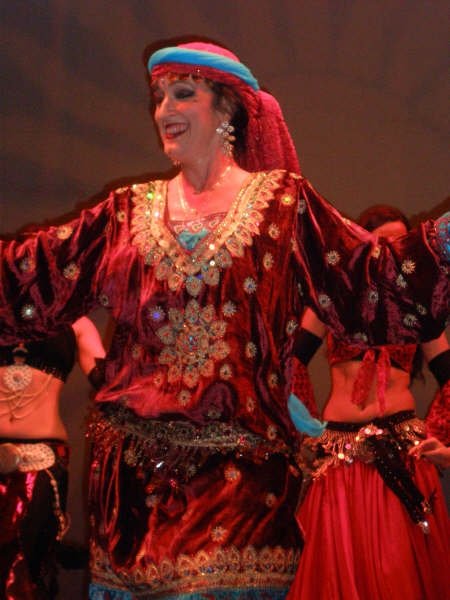
Photos: Artemis ( in black) & Tamalyn ( with headwrap)