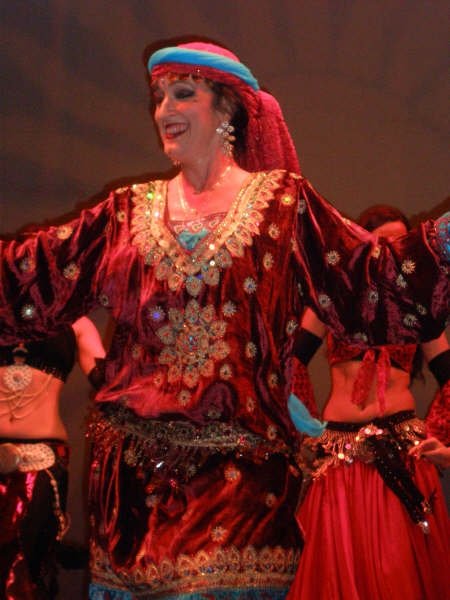
Showing posts with label Turkish belly dance. Show all posts

Sunday, September 28, 2014

DANCERS BACKSTAGE RITUALS: ALLI RUTH OF HELSINKI, FINLAND


Alli Ruth by Atelieri O. Haapala, Helsinki, Finland
 Every so often, I’ll meet a dancer whose onstage persona is so completely unlike the way she is in real life, it really throws me for a loop. One moment we’re backstage acting like complete idiots, giggling over silly things while compulsively shoving carrot sticks into our mouths.  Then, she performs a set so amazing, that when she finishes, I’m so blown away with utter fangirl appreciation, I almost feel too shy to talk to her!
 
 Alli Ruth is that kind of dancer.  Even though we’ve been pals her for years, and I’ve seen her multiple times in ratty sweats with no make up, an Ace bandage wrapped around an injury, swearing like a truck driver, I can never quite reconcile her fun, down-to-earth true self with the preternaturally elegant creature I’ve just witnessed bringing the house down onstage.  And   not only that, in her real life, she’s a librarian! To see her performing classic American and Turkish style floor work is like having a private audience with a goddess!

Photo: Atelieri O. Haapala
Alli Ruth lives in Helsinki, Finland, where she teaches and performs her specialty-and passion- American Cabaret style belly dance. She herself calls what she does “AmCab Fusion”, because  she isn’t  nearly old enough to have ever performed this style back in it’s Seventies heyday!

As White Kali in a Desert Sin performance
After moving to Finland in 2010,she realized that dancers from across the continent of Europe had a hunger for this uniquely American style, so she began teaching what she’d grown up with as a dancer. She came to belly dance in 1998, in her native Los Angeles, learning from   the masters of the American Cabaret (also known as Vintage Orientale) genre, including the late, great Diane Webber, whose unique style and considerable influence inspired another of Alli Ruth’s mentor’s, LA-based dancer Anaheed.   Dance mother to many in Southern California, Anaheed invited Alli Ruth to appear with The Perfumes Of Araby, a troupe founded by Diane Webber. In 2001, through Anaheed, she met and began dancing with Elayssa of Desert Sin, a gloriously theatrical “alternative belly dance” troupe whose influence is still widely felt in the Tribal Fusion community, and as Alli Ruth says, “whether they realize it or not!”
 
With Princess Benu in Istanbul
She has also seriously studied with other legendary AmCab performers such as Cory Zamora, Alexandra King and Princess Benu of Turkey, plus the Queen of Floor Work (and inventor of many of it’s staple moves) Anahid Sofian of New York City. Alli Ruth’s teaching and performing career  abroad has been as busy as it has been fulfilling; though like any dancer worth her salt, she considers herself a student and constantly attends workshops, classes and private lessons. By doing this, she is also preserving   a distinctive and exceptional American contribution to belly dancing.


Here, in her own modest words, is how Alli Ruth prepares for her show-stopping performances:


“I try to do as much of my makeup and prep at home, especially if I don’t know the backstage conditions, or don’t have a backstage at all. This too allows me to change my mind, for example about an eye shadow color at the last minute. I enjoy socializing backstage and would rather relax and talk to, or assist other dancers than be stuck in the mirror. It also makes more time for warming up. My warm up consists of lots of relaxed shimmies, “African Stretch” for the spine (Diane Webber used to make us do it every class), large loose hip circles, lunges and ankle, shoulder and wrist circles. 

Alli Ruth at Sutdio Iqaat, LA photo: Kat Bushman
My costuming style is what they used to call “Mixy Gypsy” so I never wear the same exact ensemble. I also never know exactly what I’m going to wear in advance. I’m famous for being frantic about “what to wear” and changing my mind about details up until the last minute. My breast size fluctuates greatly, leading to hasty alterations. My lifesaver mom is accustomed to my begging her to stitch bra hooks, and over the years I’ve taught a couple boyfriends how to use a needle and thread. Because I improv, I also have the opportunity to change my music up until the last minute, particularly if the organizer doesn’t need it in advance. What I’m getting at is that I have total ADD, which I struggle with when it comes to show prep.                                                                                                 

I’ve learned to not make or watch recordings of myself within 3 days before the show as it inevitably results in a self-critique that will cause me to change my mind, if not fall apart entirely. Also, to have many bra hook options on both the back and neck straps of my bras. I of course have a prepped gig bag and even extra, extra things that other dancers may have forgotten themselves (Belly dance karma!). 

Because I do floor work, one of the most important things is to know the condition and material of the floor to help determine the bottom half of my costume. Harem pants can get pulled by carpet (I’ve heard of dancers literally pantsing themselves) but carpet can cause serious burn on a bare leg. Some settings may have floor that is too harsh-such as pavement, be too small or placed in such a way the audience wouldn’t see you on the floor. Sometimes, floor work won’t work which factors into my music selection. 

I’m always way more nervous in the days before the performance and on the day of the show than I am when I’m about to go on. The main thing I do in the moments before coming out to dance is taking deep breaths and remind myself, it’s simply about sharing a dance. I try to remember that nobody cares so much about me that they’re going to go home and think for days about how I may have messed up; they have their own lives and concerns and nobody wants me to fail. I try to quiet my ego and dance for the joy of it. I think of all the happiness and fun I’ve experienced myself when watching other dancers and the gratitude I have towards them for this. It’s simply my turn to do the same for others, to share. This really keeps me calm and ensures a good experience. 

After my performance, it’s like I got something out of my system and just wants to return to being “Al”-my nickname amongst friends. I almost always, immediately tear off my bra and throw on a t-shirt -or a comfy cover up if I’m coming out from backstage, maybe crack a beer or pour a glass of wine.

I like dancing most at private events, where I can come both in and out as the belly dancer …and the mystique of the backstage, behind-the-scenes stays in my own home.”

 
The Snow Queen: photo by  Irina Alanko


 ##

  Sunday, October 4, 2014
Hardcore Floor: Old School AmCab and Classic Turkish Floor Work With Alli Ruth
You’ll learn ascents, descents, back bends, layouts, and some nearly extinct (and very wild) Turkish moves and Rom gestures for floor. Floor work for both drum solo and taxim will be explored.
1:30-4:30pm
Dance Garden
3191 Casitas, Ste 112
LA CA 90039
ONE DAY ONLY, $50.00
To register, contact Devillaraks@gmail.com

##

The Belly Dance Handbook: A Companion For The Serious Dancer is now  available wholesale for dance teachers and studios. To find out about wholesale order,  visit www.princessfarhana.com and click on the “email” button at the top right of the home page.
  

Saturday, September 28, 2013

IT'S A WRAP!


Tanya Lemani dancing for Captain Kirk and the rest of the team on "Star Trek"


Classic American Cabaret belly dance-also known as Vintage Orientale- is currently having A Moment. The style  is experiencing a resurgence,  becoming very popular with younger dancers , many of whom were not even born when this type of dancing  was in it’s heyday during the 1960's through the 1980's.

When I began my career in the early 1990’s, I was trained primarily in the Egyptian style, but Vintage Oriental was still very much with us, especially for restaurant dancers.  Audiences expected to see a lot of  veil and finger cymbal work.

American Cabaret  doesn’t just use music from one genre or country- it’s a lovely pastiche of many types of rhythms and  songs  from all over the Middle East,  North Africa and Central Asia. Finger cymbals and extensive veil work are a couple of the hallmarks of this style,  and  I often get requests in my workshops  to show some of the  exotic veil wraps  that were used “back in the day”. 

The old-school wrap  Photo: Lapis
If you’d like to experiment with this style, enter with your veil wrapped around you. You can use a separate veil to enter, or just come onto the stage with your cymbals a-blaze.   After an opening piece,  do a slow taxim or chiftetelli  piece,  and incorporate some veil moves.

For starters, try this simple, pretty wrap:

 Extend your left arm out and parallel to the floor. Drape your veil length-wise over it so equal halves hang in front and in back.  Make sure the hems are even and straight.  Pick up the  front half  of the veil and bring it across your chest, tucking the long hem into your bra straps and the left and right sides.

 Tuck the corner of the gathered fabric into your costume at the right hip.

 Now, take the portion of the veil that was hanging on the back of your left arm, gather it up at the far  corner, and tuck that it into the center back of your costume. If you like, you can also tuck the front  part of the veil in at each hip, and blouse it out for a billowy Grecian Goddess effect.
 
Un-wrapping the veil  Photo: Ken Vegas
 To unwrap, take the portion of the veil from the bra straps with both hands and slowly pull the veil way from you, so that the end tucked in your costume’s right hip releases. Play with the veil like this for a few moments, holding it in front of you, moving or spinning slowly. When you want to release the end of the veil that was tucked into the back, simply pull the hem of the entire veil away from you, and it will come un-tucked easily.


Sunday, November 27, 2011

DANCERS BACKSTAGE RITUALS PART SIX: ARTEMIS MOURAT AND TAMALYN DALLAL


This is part six in an on-going series of articles about the ways that well known- and in some cases, wildly famous- dancers prepare for their shows. Everyone I have spoken with has a highly personal take on getting ready for taking the stage, but one similar thing I've noticed while talking to my colleagues is that many of us seem to be very spiritual in general, and especially in relation to their dance practice.

For years, I assumed I was alone in this… but that was probably just because I just hadn’t discussed my feelings with anybody.

From the very beginning of my career, I would always become very emotional before I took the stage- and by using the word "emotional", I'm not referring to stage fright. It was more like a private, internal feeling that I would get just before I stepped onto the stage. Waves of gratitude and even disbelief would overwhelm me. Though I knew I had worked very hard for years to get to the point I was at, I would be overcome by a sense of my own good fortune and I felt humbled that I was being allowed to live out my dreams.

I have always been blessed with creativity, and I have always wanted to dance, but for me, dancing wasn’t always an easy journey. From my first performance onwards, every time I was about to dance, I would thank the universe and the heavens for being allowed this chance, and I would silently pray that that my performance would be “worthy”, both for the audience, and for whatever spiritual forces were granting me this beautiful opportunity. And I still do.

The two dancers- Artemis Mourat and Tamalyn Dallal- whose quotes you will see below, both seem to feel that in their dancing, they are connecting with a very sacred thing, in very much the same way as I do. In an odd coincidence, both of them are also writers and globe trotters as well as dancers, just like me.

Since we are in the midst of The Holidays, I thought it would be a good time to put up a post that is a bit infused with the spiritual side of dance.

Also, as I write this, I have just gotten off the phone with the highly acclaimed Artemis Mourat. She is a lovely person both on and off stage, quite down to eath and extremely funny. Our conversation was all about dance, history and culture, but of course we giggled a lot, too!

A legend in her own time, a belly dance pioneer and an expert on Turkish and Romany dances, Artemis is practically a household word in the belly dance community. She has done decades of field research all over the globe. She has also performed and taught worldwide, made music CDs and instructional DVDs, and has always been extremely generous with her wide scope of knowledge. To say that she has inspired thousands of dancers during the course of her rich career would be a vast understatement!

Here are Artemis’ words:

I pray before each show. I ask that light shine through me onto all who see me. I asked that everybody there leave the show happier than they were when they got there. I ask to be worthy to carry this torch. I ask that the blood of the dancers who have come before me should flow through my veins. And I ask for a spiritual wall of protection around me and around all of the people there.
In addition to this, I do the usual physical warm ups and one glass of wine is mighty nice.
--ARTEMIS MOURAT


Tamalyn Dallal performed and taught around the world since 1976. In addition to being a superlative dancer, has authored three books, including her latest “40 days And 1,001 Nights”, where she lived for forty days in five Muslim countries, and recorded her experiences. Not only that, she produced a documentary film and two music CDs, both based on the book! In 1990 she founded the Mid Eastern Dance Exchange, which mentored dancers all over the globe. The last time I bumped into Tamalyn, it was this past June in Cairo. I haven’t spoken to her lately, but I know she id doing a continuing documentary series called "Dance On Film" and Ethiopia is next. Here is a link to her Kickstarter site to fund the project:
http://www.kickstarter.com/projects/1758509566/dance-on-film-series-ethiopia-is-next/backers

And here is Tamalyn’s pre-performance ritual:

I usually say a prayer and consider how lucky I am to be able to dance, free to dance, and live in a place where women have the luxury of taking a dance class. So many places, people have hard lives and struggle to eke out a living and feed their families.
We are among the privileged few who can dance our hearts out in beautiful costumes for the sheer joy of it. I then think of my dance being offered to the audience as a gift.
--TAMALYN DALLAL


To read more about these infinitely inspirational dancers, please visit their websites:
Artemis Mourat: http://www.serpentine.org/artemis/artemis.htm

Tamalyn Dallal: http://www.tamalyndallal.net/homepage.html


Photos: Artemis ( in black) & Tamalyn ( with headwrap)

Wednesday, April 13, 2011

THE THINKING GAL'S GUIDE TO BELLY DANCE STYLES


PART 1: American Cabaret, Egyptian, and Turkish Style

If there’s one thing that all belly dancers have in common, it’s that we are an international collective of intelligent and adventurous women. Whether it’s a student just taking classes for fun, or a serious professional, belly dancers are uniformly curious about all aspects of the beautiful art form we practice. Though there are many theories on the subject of exactly where Oriental Dance came from, its origins remain very unclear, and though many have researched this subject intensely much belly dance history is subject not only to speculation, but to assumption, and can lead to hours of heated discussions.

To many a casual observer, the unique movements of each indigenous type of belly dance seem very similar; however, the differentiation in styles of belly dance is a little less esoteric. I’ve frequently been asked to explain the differences and/or similarities in the many styles of movement (not to mention costuming and props) that fall under the Big Belly Dance Umbrella. To an audience member, or to a student just entering the belly dance world, seeing and actually understanding the hallmarks of what makes a style “Lebanese” or “Tribal” might be difficult at first…and that’s BEFORE explaining how certain things we belly dancers take for granted -like Isis Wings, fan veils and darling microscopic top hats- all fit into the picture!

In no way do I consider the following to be a “definitive view” of belly dance in it’s myriad forms…but I do hope this series of articles can provide a thumbnail-sketch frame of reference for belly dance fans, students, and also function as a jumping off point for dance fans and curious dancers of all styles.

Under the descriptions of each genre, I have also listed the names of well-known dancers (and in many cases, legends) so that you, dear reader, can do more research yourself, or just spend a few hours getting lost on Youtube, seeing these amazing performers who practice all aspects of belly dance, in action.


AMERICAN CABARET: Until the late Eighties and Early Nineties, American Cabaret was probably the most common style of belly dancing in the USA- hence the name. Typically seen in restaurants, nightclubs and at parties, American Cabaret is basically a pastiche of movements from various North African and Middle Eastern nations like Egypt, Greece, Turkey, Lebanon and Syria ( to name a few) as well technique and/ or gestures appropriated from Indian Armenian, Eastern European and Balkan folk dances, all incorporated into a style made palatable to the Western “idea” of belly dancing.

Ethnic clubs proliferated on New York’s Eighth Avenue in the Fifties and early Sixties and dancers working there or in other ethnically populated areas learned from immigrants, but there was also a good degree of supposition, fantasy and creative artistic license involved. Many of our pioneering Western dance sisters didn’t have access to study the authentic or indigenous dance forms, and therefore occasionally invented the dance as they went along, taking cues from everything from Ruth St. Denis to Hollywood’s early motion pictures to Orientalist paintings.

Due to these influences, a good dash of showmanship, and the required long sets performed by night club dancers “back in the day”, who were usually accompanied by a multi-ethnic live band and singers, the eclectic mix ‘n’ match aspect was then honed into a professional five-part routine. The basic premise for the standard routine was becoming “the industry standard” and usually went something like this: a dynamic entrance song with finger cymbals, a slow taqsim, (often incorporating veil work and floor work) another upbeat or folkloric- type song, a beledy progression, drum solo and exit. Sometimes there was also audience participation or a specialty act ( debke, raks assaya, khaleegi, a scimitar dance, etc.) thrown into the mix as well.

American Cabaret is the type of belly dancing you might see in a nightclub scene in sixties or seventies movie, or portrayed in a James Bond flick. Belly dancing was hugely popular during the late sixties and early seventies, and filmmakers directing movies and television show picked up on the nation-wide trend, which was also popularized as a commercial fad. There were many instructional books and records on belly dancing made during this time, including the LPs “How To Belly Dance For Your Husband” and “Turn Your Husband Into A Sultan”. There were also many records produced featuring Middle Eastern music, such as those by Mohammad Bakkar, The Sultans, and Eddie “The Sheik” Kochack.

Additionally, many earlier American Cabaret dancers used to hand sew their own coined costumes and chiffon veils; and often wore harem pants, Turkish vests, gauntlets on their arms and sometimes tiny Turkish-style pill-box hats decorated with beads. Again, the hand-crafted costumes came about because decades ago, there was there was no access to the genuine article.

This style of performance never really disappeared, though it began waning in popularity with the rise of Egyptian style belly dance in the late eighties and early nineties. Still, many performers adhered to the five-part routine and audiences gobbled up shows featuring extensive veil work and use of finger cymbals. When Egyptian style became popular, the art of floor work was almost lost, as it’s absent in most forms of Egyptian dance.

Today, American Cabaret style is once again experiencing a huge resurgence in popularity. Dancers still wear coined or beaded costumes, ( and often search out vintage “fringe monster” costumes as well!) and use veils or even double veils, finger cymbals, and/or other props in their routines, as well as incorporating floor work, and working withmany rhythms, including 4/4, 9/8, and 6/8. Just a few famous American Cabaret performers include Helena Vlahos, Suhaila Salimpour, Aziza, Fahtiem, Delilah, Sadie, and Dahlena.

EGYPTIAN
: Within Egyptian-style raks sharqi (in Arabic: “dance of the east” or “Dance of the Orient”- hence the English term “Oriental Dance”) there are many sub-genres. Whether raqs sharqi is performed to classic orchestrated music, or more modern Egyptian pop, this style has many distinct hallmarks, including stepping on the downbeat, and the fact that the dancer is almost always elevated onto the balls of her feet, with the weight slightly forward and the knees soft and never locked. Some other trademarks of the Egyptian style: intricate hip articulations, both traveling and stationary shimmies, intricate abdominal work, and full-body poses. Internal as well as external muscle movements are incorporated, and some of the resulting technique is so subtle that the casual observer or layperson may not even realize it is going on. Technique also includes isolations, distinct hand gestures and surprising speed changes.

A dance performed to classical Egyptian music, like an Om Kalthoum or Mohammed Abdel Wahab song may seem to be a bit more emotive or visually “demure” than Modern Cairo style, which has become extremely athletic in recent times, due to innovations from newer performers like Dina and Randa Kamel. Still, most performances include a flirtatious, ultra-feminine attitude.

A “Modern Cairo” style dancer performing to Egyptian music might incorporate bits and pieces of ballet, jazz and even hip-hop, while still maintaining the dance’s Oriental style.

Egyptian folk dance is another sub-genre, with too many variations to even mention here. Though much Egyptian folkloric styles were traditionally performed flat-footed, brilliant, legendary choreographer Mahmoud Reda changed that by incorporating ballet when he adapted regional folkloric styles for The Reda Troupe’s staged performances.

The Egyptian-style Oriental dancer used to wear lavishly beaded couture costumes- and for years, in Egypt it was mandated that the midriff be covered, usually with a net body suit. The trend today in Egyptian costuming is more towards minimalism and clingy Lycra.

Egyptian style dancers rarely play finger cymbals, though this is usually because in Egypt, the dancer performs with a band or large orchestra, and it is not necessary…it does NOT mean that the performer doesn’t know how to play them OR that playing them is incorrect!

Egyptian style Oriental dancers do not perform floor work (it is actually against the law in Egypt) and typically the dancer only uses a veil only during her entrance, or “magency” (spelled phonetically in various ways). Some legendary Egyptian dancers: Samia Gamal, Tahiyya Carioca and Naima Akef, all from the 1930’s-1950’s; Nagwa Foud, Soheir Zaki, Fifi Abdou, (1960’s-1980’s) Mona El Said, Aida Nour, Lucy, Dina, Randa Kamel. Internationally acclaimed Egyptian oriental choreographer Raqia Hassan was Reda-trained, and though she never performed raqs sharqi herself, is known for coaching the greats both in Egypt and around the world in that style. Some American performers known for Egyptian Style are Sahra Saeeda, Ranya Renee, Cassandra Shore and Roxxanne Shelaby. Many cite Jillina as an Egyptian performer, while others argue that her style is too jazz and ballet-influenced.

TURKISH: More lively and athletic than Egyptian style, much of Turkish “Oryantal” dance is based upon Rom or Romany (colloquially and incorrectly called Gypsy) dancing, still practiced in the Sulukele Quarter of Istanbul.

Turkish cabaret-style dancers usually wear costumes that sit higher on the hip than Egyptian costumes, with full chiffon skirts that show a lot of leg and fly during the quick turns, whirls, spins and hops that are the hallmarks of this style, as are deep backbends and floor work. Turkish costumes have remained exquisitely embellished with fringe and stones even today, whereas their Egyptian-made counterparts have been more sleek and minimalist. With the rise of the Internet and global awareness, many dancers prefer the intricately made Turkish costumes, such as those made by the ateliers of Bella and Legend.

Some of the Turkish-style gestures may seem almost aggressive, such as fists pounding onto the dancer’s hips, or the straighter, almost sharp arm positions used. Larger full-body moves are also showcased: earthy, pelvic-drop shimmies; quick torso-snaps and isolations, and spirited hair tossing. Floor work is also performed, and quite athletically. Finger cymbals are usually played in quick 3/4 or 9/8 time signature, veils are used extensively, and the dancer may or may not wear heels in performance. This style of dancing really influenced American Cabaret in the Sixties and Seventies.

And after a heavy swing in the USA towards Egyptian style dancing, Turkish belly dance is now experiencing a resurgence of interest and practice among a younger generation of dancers, such as Portland, Oregon’s Ruby Beh. Some famous Turkish dancers: Tulay Karaca, Ozel Turkbas, Nesrin Topkapi, Princess Benu, Bergul Berai… and Didem Kenali is currently very well-known for her performances on Turkish television. Dilek, a beautiful dancer with many awards to her name, is Turkish but currently lives in California. Male dancer and choreographer Ozgen (formerly of Istanbul, now of UK) performs globally, both in the Oryantal and Rom styles. Venerated American dancers who specialize in Turkish style are Eva Cernik and Artemis Mourat; and there are many other American dancers who perform either straight Turkish or Turkish-influenced dancing such as Michelle Joyce, Sarah Skinner and Sandra.


Stay tuned to this site for Part Two!

Wednesday, July 22, 2009

THE BIG O


When I found out that Turkish male belly dance star Ozgen was coming to Los Angeles for a few days of vacation, I laid down the law: he simply had to do a workshop and a show.

Born in Istanbul and living in London, Ozgen is an international star who has been dancing since childhood. Trained in ballet, jazz, modern and ballroom styles, he’s been specializing in Turkish Romany ( Roman Havasi) and Oryantal dance for almost fifteen years. For years he was an instructor and choreographer at the Tolghan School in Turkey; he currently performs and teaches sold-out workshops all over Europe and the Far East.

I often joke that Ozgen was one of the best birthday presents I ever got: we met two years ago on my birthday in London, backstage at The Shimmy Shake Show at the venue Madame Jo-Jo’s in Soho, and have taught and performed together at Festival Fantasia, also in London. The night we met, we immediately got along like gangbusters, but after I saw him perform, like everyone else in the audience, I fell in love! He is ridiculously talented, technically amazing, and has incredible spinal and upper-body flexibility, allowing his movements to be both precisely sharp and almost bonelessly liquid at the same time. The pure love and passion he brings to his dancing is evident, and infectious to anyone who has the pleasure of watching him.

When I found out this gem was coming to LA, I knew I wanted to do an event with him- the only hitch was that I was leaving for Egypt to teach and perform at Ahlan Wa Sahlan the very next week, and he was coming mere days after I would return. Thankfully, Nasila and Melia from LA Raqs stepped in, and together we co-ordinated and promoted an Ozgen extravaganza, at Studio Iqaat. All I can say is, The Internet made it all possible- we emailed about everything, setting performers, deciding on curriculum and getting details together-and advertised- while I was at Ahlan Wa Sahlan in Cairo. In fact, both Aubre and Fahtiem, guest-stars at the show, were in Egypt at the same time I was, and so I roped them into performing while they were riddled with jet-lag!

Both the workshop and the show sold out. The workshop , where Ozgen contrasted the similar-yet-unique movements of both Turkish Oryantal and Romany dances, drew in avid students as well as local professionals like Rania, Lee Ali, Marguerite Kusuhara, and Celeste of IAMED. Ozgen’s teaching style is facile with clear breakdowns, and he made sure everybody learned about and understood the sociological and cultural inferences in the various gestures he demonstrated. His English skills are fantastic , and though the class moved a long at a good clip, his spot-on teaching is infused with humor and wit. He charmed everybody with his cute non-traditional names for footwork patterns and with his verbal expressions as well- at one point he referred to the flirtatious shoulder movements of Turkish Oryantal as “cuddly”!

Los Angeles has long been a hot-spot of Oriental dance, with many world-class performers living in the city, so the show had an all-star line-up. Audience members were literally astounded at the name performers participating. In addition to Ozgen, Aubre, Fahtiem, Nasila and myself, the evening also included Tamra-Henna, up-and-coming LA-based male dancer Richy Nedjat, and last-minute guest, Rania, who signed on as a surprise wild card at 11:30 pm the night before the event!

Noted Arabic percussionist and Studio Iqaat owner Donavon Lerman pulled together a small Arabic ensemble to kick the show off with live music; and a Turkish band featuring Vedat on saz and vocals, Jessica on clarinet, and Donavon himself on tabla. Rania kicked the evening off performing to “Mavi, Mahvi” on CD, followed by Nasila performing to “Leylet Hob” live, Richy interpreting “Eshta Ya Amar” , Tamra Henna doing “We Deret Al Ayam” in a stunning red Sahar Okasha, and Aubre doing a hot Saidi Assaya. Fahtiem and I both opted to perform to the live Turkish band, and it was amazing to watch Fahtiem performing Turkish, since she so rarely does. For my part, I loved dancing to Turkish music, and I got chills with Jessica’s gorgeous clarinet taxim during my show.

Ozgen performed twice: his first piece, a Romany dance ( a version of which I heartily encourage readers to view on YouTube!) had the entire audience screaming, it was so full of attitude and unbridled machismo. His second show was pure Oryantal, quick-paced, dynamic and thrilling. He even did snakey floor work-complete with backbends- while Jessica played him an extended taxim. He ended his piece with a mind-banding, spine-snapping Turkish drop…then got up quickly to lure the audience out for open-floor dancing, which continued on for quite a long time.

The very next morning, he left for the airport, and back home to London.

All I can say is…if you have the chance to see or study with this incredible dancer- don’t even think about it- JUST DO IT!
For more info on Ozgen, please visit www.ozgen.co.uk