Showing posts with label Romany Dance. Show all posts

Sunday, November 27, 2011

DANCERS BACKSTAGE RITUALS PART SIX: ARTEMIS MOURAT AND TAMALYN DALLAL


This is part six in an on-going series of articles about the ways that well known- and in some cases, wildly famous- dancers prepare for their shows. Everyone I have spoken with has a highly personal take on getting ready for taking the stage, but one similar thing I've noticed while talking to my colleagues is that many of us seem to be very spiritual in general, and especially in relation to their dance practice.

For years, I assumed I was alone in this… but that was probably just because I just hadn’t discussed my feelings with anybody.

From the very beginning of my career, I would always become very emotional before I took the stage- and by using the word "emotional", I'm not referring to stage fright. It was more like a private, internal feeling that I would get just before I stepped onto the stage. Waves of gratitude and even disbelief would overwhelm me. Though I knew I had worked very hard for years to get to the point I was at, I would be overcome by a sense of my own good fortune and I felt humbled that I was being allowed to live out my dreams.

I have always been blessed with creativity, and I have always wanted to dance, but for me, dancing wasn’t always an easy journey. From my first performance onwards, every time I was about to dance, I would thank the universe and the heavens for being allowed this chance, and I would silently pray that that my performance would be “worthy”, both for the audience, and for whatever spiritual forces were granting me this beautiful opportunity. And I still do.

The two dancers- Artemis Mourat and Tamalyn Dallal- whose quotes you will see below, both seem to feel that in their dancing, they are connecting with a very sacred thing, in very much the same way as I do. In an odd coincidence, both of them are also writers and globe trotters as well as dancers, just like me.

Since we are in the midst of The Holidays, I thought it would be a good time to put up a post that is a bit infused with the spiritual side of dance.

Also, as I write this, I have just gotten off the phone with the highly acclaimed Artemis Mourat. She is a lovely person both on and off stage, quite down to eath and extremely funny. Our conversation was all about dance, history and culture, but of course we giggled a lot, too!

A legend in her own time, a belly dance pioneer and an expert on Turkish and Romany dances, Artemis is practically a household word in the belly dance community. She has done decades of field research all over the globe. She has also performed and taught worldwide, made music CDs and instructional DVDs, and has always been extremely generous with her wide scope of knowledge. To say that she has inspired thousands of dancers during the course of her rich career would be a vast understatement!

Here are Artemis’ words:

I pray before each show. I ask that light shine through me onto all who see me. I asked that everybody there leave the show happier than they were when they got there. I ask to be worthy to carry this torch. I ask that the blood of the dancers who have come before me should flow through my veins. And I ask for a spiritual wall of protection around me and around all of the people there.
In addition to this, I do the usual physical warm ups and one glass of wine is mighty nice.
--ARTEMIS MOURAT


Tamalyn Dallal performed and taught around the world since 1976. In addition to being a superlative dancer, has authored three books, including her latest “40 days And 1,001 Nights”, where she lived for forty days in five Muslim countries, and recorded her experiences. Not only that, she produced a documentary film and two music CDs, both based on the book! In 1990 she founded the Mid Eastern Dance Exchange, which mentored dancers all over the globe. The last time I bumped into Tamalyn, it was this past June in Cairo. I haven’t spoken to her lately, but I know she id doing a continuing documentary series called "Dance On Film" and Ethiopia is next. Here is a link to her Kickstarter site to fund the project:
http://www.kickstarter.com/projects/1758509566/dance-on-film-series-ethiopia-is-next/backers

And here is Tamalyn’s pre-performance ritual:

I usually say a prayer and consider how lucky I am to be able to dance, free to dance, and live in a place where women have the luxury of taking a dance class. So many places, people have hard lives and struggle to eke out a living and feed their families.
We are among the privileged few who can dance our hearts out in beautiful costumes for the sheer joy of it. I then think of my dance being offered to the audience as a gift.
--TAMALYN DALLAL


To read more about these infinitely inspirational dancers, please visit their websites:
Artemis Mourat: http://www.serpentine.org/artemis/artemis.htm

Tamalyn Dallal: http://www.tamalyndallal.net/homepage.html


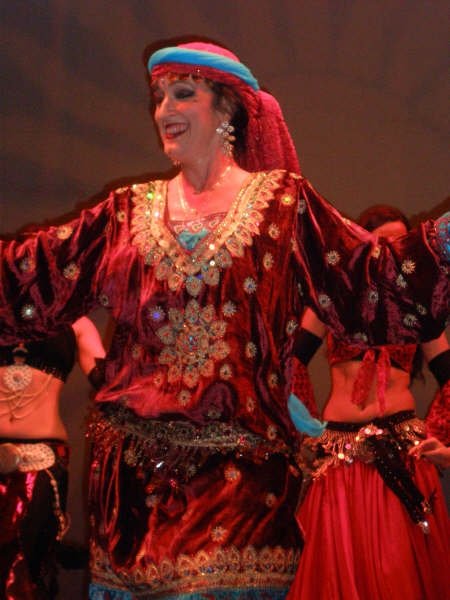
Photos: Artemis ( in black) & Tamalyn ( with headwrap)

Monday, May 2, 2011

THE THINKING GAL'S GUIDE TO BELLY DANCE STYLES PART FIVE: ROM, ROMA OR ROMANY DANCE


This is Part Five in my series of identifying the various styles of oriental dance. As with my previous articles, I will again state that in no way do I consider the following to be a “definitive view” of belly dance in it’s myriad forms…but I do hope this series of articles can provide a thumbnail-sketch frame of reference for belly dance fans, students, and also function as a jumping off point for dance fans and curious dancers of all styles. As with past pieces I have written, please note that many of the names mentioned may be spelled in various ways to phonetic pronunciation and translations. This article is about the influence of the Roma on oriental dance.


Though it is considered politically incorrect and degrading to refer to the Rom or Roman people as gypsies, that is how most people refer to them. Many scholars and historians believe that the Romany people had a profound influence on belly dance as we know it, but because of the lack of written history on these talented nomads, it’s unclear as to what degree.

The Roma are believed to have origins in Northern India, due to linguistics and physical characteristics, and there are still several distinct tribes of Roma in the Rajasthan region. Though it is uncertain why many of them left India, it is believed that they have been nomads for over a thousand years, and entered Eastern Europe in the 1300’s. Because they came from the east, they were thought to have been from Turkey or Egypt, and were apparently often called Egyptians, or “ ‘Gyptians”, which is where the word “gypsy” originated. The Roma people migrated across the globe for centuries, and were often forced to, due to prejudice and persecution. Unfortunately, there is still much discrimination being shown towards these people today. The Kanjar tribe of musicians, acrobatic entertainers and dancers are the branch credited with leaving a legacy of incredible music and dancing that has influenced every country they wandered through, especially in the Middle Eastern, Eastern European, Mediterranean and North African regions.

In Rajasthan, there are many tribes who are considered “lower caste” but eke out a living as their forebears did by performing dance. Some of these tribes are the Banjara, the Domba, the Khalbelliya (famous as snake charmers) the Kuna and The Bopa. The award-winning film about Roma migration, music and dance, “Latcho Drom”, opens with an incredible segment of a Rajasthani Roma woman dancing, doing non-stop barrel turns in an incredible traditional Rajasthani full-skirted dress.

Per se, Roma or Roman dancing is not what the lay person would think of as belly dancing, but it’s easy to see where their influence came in: signature movements connecting Roma dance and belly dance are obvious, in the patterns of the footwork, certain hip articulations, torso undulations wrist circles, and the gestures of the arms.

Even today, there are many Roma among the professional musicians and dancers working as entertainers in Turkey. Though Turkish “Oryantal” (cabaret) dance, with its Arabic influence is much different than it's far more earthy cousin,Turkish Roman dance, there is still an undeniable connection.


In Spain, for centuries as well as up to the present, many of the most celebrated Flamenco artist’s were-and are- of Rom or gypsy descent. It’s plain to see that the technique of Flamenco and belly dance share many similarities, and it is believed that this type of dancing originated during the middle Ages, when the Moors invaded Spain. In southern Spain, a Flamenco variation called the Zambra Mora is performed barefoot, and is sometimes considered to be the “missing link” between Flamenco and belly dance.

In Luxor, Egypt, live sisters that are the last members of the Mazin, family of legendary professional dancers and musicians known as The Banat Mazin. Known internationally as The Ghawazi, the word loosely translates to “invader” or “foreigner” in Arabic, with the plural form being Ghawazi, and the singular being Ghaziya. The Mazin family is thought to originally be of the Nawar (sometimes referred to as Nawari) tribe, and to have perhaps migrated from Persia centuries ago to settle in Egypt. The Mazin family gained much renown for their distinctive dance skills, and speak a dialect much more similar to Rom than it is to Arabic. The signature style of the dance includes extensive work with finger cymbals, and arm positions that are relaxed, and bent at the elbows, very unlike Raks Sharqi. The Ghawazi costuming is also very different- they wear shorter dirndl style skirts covered in rayon fringe and paillettes, with the skirt being worn at the waist as opposed to the hips, with matching tops; sometimes they can be seen in long, gallibiya-style balady dresses. There is also the ever-present taj or crown, unique to the Ghawazi.

The work of the sisters and their unique, deceptively simple genre of dance has been documented and recorded by many oriental dance researchers, including Edwina Nearing and Aisha Ali. Khairiyya Yusef Mazin still lives in Luxor, and is the last remaining original proponent of this lovely style, earthy style.

The link below will take you to a clip from the Golden Age Egyptian film “ Ana Al Dacteur” (“I’m A Doctor”) released in 1953, which features Balady style dancer Nawal El Saghera, as well as the four t Mazin sisters, as well as some male dancers performing tahtib (stick) dances. As a side note, the extremely young and beautiful singer performing is Fatma Serhan. Known as “The Queen Of Balady”, listen to her distinctive voice and you will recognize her work of almost a half a century later, from her performances as Dina’s singer, and their work together on Dina’s signature song, “Tahtil Shebak”!
http://www.youtube.com/watch?v=a-t2098G1Ko

Some extremely well known dancers who specialize in Roma dances are Eva Cernik,(Turkish Rom), Artemis Mourat, Hadia, Laurel Victoria Gray (Russian Rom or Tsingani dance); Dahlia Carella; and Aisha Ali and Edwina Nearing for their extensive study of the Ghawazi.
Morocco is not only a splendid dancer and an authority on oriental dance ethnology but is actually Rom herself- her given name is Carolina Varga Dinicu.

Also check out the gorgeously shot 1993 film “Latcho Drom”, a French documentary on the Romany journey, written and directed by Tony Gatliff. Following various groups of Rom from India, Eastern Europe, Spain and into North Africa, and mostly music and dancing, t he title means “Safe Journey” in the Romany language.

And if you get as carried away by all of this as I do, you absolutely must check out Isabella Fonseca’s excellent book on the Romany people, “Bury Me Standing: The Gypsies And Their Journey”, which has had many editions in hardcover and paperback, and is now available for Kindle.

###
Photos:
Color photo: Banjara women from Rajasthan
B&W photo: The Banat Mazin