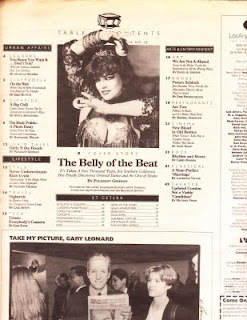
My, how time flies! Sometimes I cannot believe I have been belly dancing- and writing about belly dancing- for nearly two decades. In my Royal Archives ( also known as the dusty jumble of boxes on the shelves above my costume closet ) I recently unearthed the following story,
The Belly of The Beat, which I wrote under my given name, Pleasant Gehman, for the April 22, 1994 edition of
The Los Angeles Reader, a large weekly newspaper I worked for extensively in the early Nineties. At the time I wrote the story, I had been dancing professionally for three years, and had absolutely no idea that fifteen years later, I would not only still be belly dancing, but performing and teaching internationally!
Needless to say, much has changed in the international world of belly dance since then... to begin with, back in those days, there was no Internet, no Belly Dance Super Stars, very few competitions and dance festivals, and it was difficult to buy costumes from Egypt and Turkey- many dancers made their own. We used cassettes and VHS tapes, not iPods and DVD's, and so on. Even so, the dance scene in Southern California was then-and continues to be- a hotbed of Oriental Dance. Many of the names you will see in the story- Sahra C. Kent, Fahtiem, Angelika Nemeth, Mesmera, Tonya and Atlantis and many others- are still quite active performing, teaching, writing about our beloved dance. I hope you enjoy this walk down memory lane- published here as it exactly as it appeared in the
LA Reader in 1994.
* * * * * * * * * * *
The lighting is dim and reddish, the air heavy with smoke, and all that matters to the crowd, which is getting a little feisty behind tables heaped with an orgy of food and wine, is the drum. The drum, and, of course, the girl dancing to it, being led by it.
Jaqueline Eusanio is a blur of gold and black sparkles, cascade of russet, waist-length hair, a glimpse of thigh. She twists and turns slowly. Her eyes are closed, and the look on her face is distant and trance-like. She moves parts of her body most people don’t even know exist. Then suddenly, there it is—louder and more insistent this time— the drum, the drum, the drum. She starts spinning and finally, in perfect time with the beat, collapses to the floor in a spine-snapping backbend, perfectly executed. As the music swells up once again, a man in a suit steps forth and solemnly rains a thick wad of cash onto her, bill by bill, to the wild cheers of the cheers of the onlookers.
It sounds like a scene from a James Bond movie, but it’s Los Angeles—Burbank, actually—1994, and it’s just another Wednesday night at The Middle East Connection, a tiny hole-in-the-wall that transforms itself once a week onto a haven for dining and entertainment, Middle Eastern-style. That, of course, means belly dancing, which is very much alive and well these days, especially in Los Angeles, though many people aren’t aware of it. In fact, most people know very little about belly dancing, viewing it as a carnival sideshow attraction or some left-over fad from the Seventies. This couldn’t be further from the truth. The movements, correctly known as Oriental dance, have been around for thousands of years, and were performed in various styles and combinations all over North Africa and the Middle East.
One of the oldest dances on earth, it’s origins are cloudy. Some believe it represented fertility rights and was connected to pre-Islamic Goddess worship. Others claim the dance originated in India, with Gypsies, and was spread through out the Orient in their travels and migrations. It’s easy to follow the “Gypsy Trail,” as scholars call it, through Afghanistan and Persia, on into Turkey, where there was a split with one branch of Gypsies trekking through North Africa and the other meandering toward Eastern Europe. Even in modern Egypt, the term for dancers in rural villages is ghaziya, which is singular for ghawazee, meaning “invader” or “outsider.”
The original ghawazee were not of Egyptian origin. Egypt, however, has been a Mecca for Oriental dance for centuries. The women’s solo dance in it’s Egyptian social form is known as raks al-beledy (dance of the people) and is still practiced today, handed down from generation from generation. When it was refined by professionals whether they were courtesans or performers, it took on a slightly different aspect: the movements became more complex and less folkloric, and were tempered with nuances from other countries. This hybrid became known in Arabic as raqs al sharqi, ”dance of the East”- hence “Oriental dance” and was observed by the many travelers, writers, and painters who went abroad during the 19th century. The movements, especially of the hips and abdomen, had never been seen by westerners and caused a sensation.
Eventually, word of the amazing Oriental dancing girls spread to the West and the demand to see them grew. At the Chicago World’s Fair in 1893, Oriental dance made its American debut on the Midway Plaisance. Of the entire Midway, which featured exhibits from Japan, Germany, Holland, Italy, and Ireland among other countries, the attractions that drew the largest crowds were those with the famous dancing girls-The Turkish, Tunisian, Algerian, and, of course Egyptian. “Little Egypt,” as the most famous dancer was known, not only attracted huge crowds but scandalized the Victorian rubes to no end. To their uneducated eyes, her movements, considered highly skilled and artistic in the Orient, were obscene. Thus began a hundred years of misconceptions and bad press, which were only heightened by the late-Seventies belly-dance boom, in which enthusiastic but misinformed house wives donned veils and set out to turn their husbands into “sultans.”
“Ninety percent of Americans don’t know what it means, belly dance,” says Ben Mahmoud, owner of Moun of Tunis of Restaurant in Hollywood, where belly dancing is featured nightly. “It is like speaking out, like a communication, something in North Africa that you grew up with. It’s in your blood. Belly dancing is not stripping. It’s a language between the dancer and the audience.”
“People are finally becoming aware of the dance in a cultural way; it’s becoming less of a novelty and more mainstream.” says Feiruz Aram, a well- known Long Beach dancer who has worked through out the United States (as well as in Cairo) and has been teaching for more than fifteen years.
“With World Beat music getting so popular, Walt Disney’s Aladdin, and even Prince featuring belly dancers, it leads me to believe that Oriental dance will be intergrated into other dance forms.”
That concept worries some purists, who frown upon “fusion” of dance form and musical styles, but Michelle Forner, who regularly dances at Dar Margreb Restaurant in Hollywood and has a degree in dance ethnology from UCLA, disagrees.
“How can you keep something like this pure?” she asks. “It’s gone through so many changes, it’s hard to define. It’s not like ballet, where there are certain rigid steps.”
“There is no standardization,” says Zahra Zuhair, a petite grey-eyed woman who has been dancing for more than 16 years. “We’re still suffering from the Seventies, when people would just put on a costume and jump around, but these days there are a lot of good things going on. We have a very high caliber of dancers here in L.A… but anything can look strange when it’s taken out of cultural context.”
The culture "thing" is a big barrier- but not insurmountable. Anaheed, the vivacious dancer who runs the Wednesday program at the Middle East Connection, traces five generations of Oriental dancers in Los Angeles.
“The first was in the Forties and Fifties, when women came over or were brought over from the Middle East.”,she says.
“Then there was the second generation-well known dancers who learned from those women, and became teachers themselves, Jamila Salimpour, Marta Schill, Diane Webber, Aisha Ali. The third generation is people like me who learned from the second. The fourth generation is dancers who never experienced the club-scene here… it was huge. There were lots of clubs, like The Fez, Coco’s International, Omar Kayyan, Ali Babas-they all had old-style bands with live musicians-violin, oud, [a sort of oriental guitar], dumbek [drum]. The fifth generation is just now beginning to get their first dance jobs.”
The club scene fizzled in late Eighties Los Angeles for a variety of reasons, one being the economy: people were no longer willing to spend a lot of money on live entertainment.
“ The Gulf War really had an effect,” says Marta Schill, one of the founders of The Middle Eastern Culture and Dance Association (MECDA), which is a special-interest group for dancers but began in the late seventies as a union for women who worked in the clubs-The Middle Eastern Cabaret Dancers Alliance.
“In the late seventies and early eighties, there were over thirty-eight clubs in the area, and a lot of money was coming in from the Middle East,” Schill says. “The hostages and the Gulf War were the end of that, though. Some clubs went out of business over night.”
“There’s been resurgence, though, definitely,” says Aisha Ali, a respected dancer, teacher and choreographer whose field recordings of music from Northern Africa are now in their tenth printing.
“Dancers are learning much more now, and getting away from the self-styled and more into the entire culture. It’s not so much only in nightclubs and restaurants; people are looking into the dance for research and even for fitness.”
Angelika Nemeth, Orange Coast College’s Middle Eastern dance doyenne, suggests total immersion. “For the serious dancer, you have to go to Cairo, travel through the Middle East--- take classes, broaden your horizon. It’s not all nightclubs.”
Shareen El Safy publishes Habibi, which, along with Arabesque, is the leading Oriental dance trade paper, and features scholarly articles alongside costume hints and ads for dance workshops, costume swap meets, reviews of music, and performance videos. A veteran dancer and instructor, El Safy has traveled extensively and conducted workshops and tours of Egypt for years.
“When you travel a lot, you can tell Los Angeles is different,” she says. “There’s more of a Hollywood, show-biz influence here…the seven-part dance routine, use of a veil, that look of glitz and glamour. But there are also many professional dancers in LA, so there’s a really high level of skill. I think we’re going to be moving out of the clubs soon and into more concert-level productions.”
Still, the nightclub or Middle Eastern restaurant is the main place of employment for most belly dancers. Although clubs with live bands may not be as prolific as in years past, Oriental dancers still have many venues from which to choose, encompassing Greek, Persian, Turkish, Armenian, Moroccan, Tunisian, Lebanese, and Egyptian. Aside from Dar Magreb, Moun Of Tunis and The Middle East Connection, there are Darband, Marrakech, The Plaka, Burger Continental, Katoubia, Al Amir, The Athenian Gardens, Port of Athens, Byblos, Colbeh, Aladdin, Corfu Island, The Athenian, and many other venues featuring Oriental dance around town.
“These days, you’ve got to be versatile,” Anaheed says. “You’ve got to be able to dance to Greek or Persian music, which is different from Arabic. If you’re dancing to a tape, you have to make it look as exciting as though it was live. If it’s live, the drummer could be playing with you, making you look bad. You’re not under contract, you work week-to-week. There’s no insurance, and the tips are split. You have to decide that you’re willing to put up with all of it in order to perform your art.”
Not to mention the long hours waiting in dressing rooms that are usually supply closets or offices, inhaling cigarette smoke, dealing with overenthusiastic patrons who think it’s correct etiquette to grab at you or tip you with money held in their teeth…and, of course, the inevitable drunk who wants to see you roll a quarter on your belly. (Yes, it can be done by almost anyone who can perform a stomach undulation, but most dancers relegate that sort of performance to the “circus trick” category.)
“And then there’s the irony,” says Shahira, 1993 winner of the Egyptian Category of the Southern California International Belly Dancer of The Universe Competition, “That you don’t know the language—you have to be able to compete with Arabic girls who know what all the words mean and sing along while they dance, which audiences love.”
Noura, a Syrian native who lives in Los Angeles and works at the elegant Al Andalus in Studio City, has the advantage of being fluent in Arabic and English, but is just as cognizant of the competition. “In my country, or in Egypt, it is absolutely different,” she says, “The audience appreciates the dancer much more. Also, the club makes contracts with her. Here, there are lots of dancers, and some of them are kind who go see somebody dance, and then they think, ‘Hmm…I think I’ll take her job.’ You know?”
“There are lots of opportunities to dance here, though,” says Melissa Berger, a dancer and actress who recently appeared belly dancing in an episode of Brisco County, Jr. along with Jacqueline Eusanio and Atlantis. Television and movies have provided work for dancers like Veena Badasha, Fahtiem (who is a ringer for Ann Jillian, and a proficient Oriental dancer), Europa, Anaheed, Mesmera, and Michelle Forner. But the work isn’t steady—club and restaurant gigs are.
“This is how I make my living—performing and teaching.” says Fahtiem, who also heads the troupe Sultan’s Delights. “I don’t ‘do’ anything else, it’s not a hobby.”
Adds Forner: “I dance for tips—we all do. But there’s a line I will draw, like when some man is trying to grab me.”
“You know, most people who see Oriental dance see it as a beautiful art form, but there are some people for whom the stereotype still exists—or who are misinformed,” says Zahra Zuhair.
“Western audiences don’t know any better, because sometimes the dance is taken so far out of context, and there’s constant bad press focusing on it being so sexy. It’s sensuous, yes, but never blatant. I mean, this is a part of a culture. There’s a dancer at every wedding—Arab women learn this as children!”
“Unfortunately, a lot of places don’t afford the dancer an appropriate way to express herself,” says Eusanio, who is working on her dance degree at Pierce College.
“Oriental dance is a unique feminine expression, because no dancer will ever dance like any other—but it’s serious! You have to have a passion for it, be devoted to it—if you aren’t, then you shouldn’t be doing it, because it needs to taken up to the next level.”
Fahtiem agrees. “The general public really needs to be educated,” she says in a soft voice. “Most of the people I dance for are American, and they’re shocked. They’ll say, ‘My gosh—that’s really artistic!’—my feeling is that we need to transmit that this is an art, even in little ways, like belly-grams. I did one at an Acapulco [restaurant] the other day, for a dentist at lunchtime…I mean, these are people who never would’ve gone to a Middle Eastern club. To them, you’re representing the whole genre, and you have to do it with dignity and show them you have skills, and that you’re a professional—and a lady.”
At Orange Coast College, Nemeth teaches nuances of Arab culture along with the dance steps, and has presented a series of folkloric dance concerts to the students and faculty, most of whom would never have made it on their own to the clubs and restaurants that feature belly dancing. Aside from raks al sharqui and beledi, there are many traditional dances— raqs shamadan, which involves balancing a large candelabra on the head (an Egyptian wedding tradition), Turkish scimitar (a curved sword) balancing, the used of zills, (Turkish for finger-cymbals; in Arabic they’re called sagat) canes (raks assaya), handkerchiefs, and Moroccan tray dancing, which also involved balancing the object on the head, and is traditionally done by men.
Yes, indeed, there are male belly dancers. In the tradition of ballet, many of them are excellent teachers and choreographers, as well. Though dance is a daily part of life in most North African or Middle Eastern countries, and many dances are the sole property of men, Western culture has traditionally emasculated most dance forms unless they are a display of athletic prowess.
“It’s dicey here, you have to get beyond the Chippendale’s mentality,” wearily laughs Zain Abd-Al Malik. Well over six feet tall, Abd-Al Malik is even more imposing when his heavy brass tray is balanced on his head. A Los Feliz resident, he’s danced all over the West Coast, and even in Morocco and Saudi Arabia, where he lived in a royal palace for nearly a year. An article on that experience, “Bel Air, Beirut, And Beyond” was just published in Habibi, and he will be on the cover of Arabesque this spring. Although Abd-Al Malik is concentrating on scholarly research and teaching these days, he has a lot to say about performing.
“To American audiences, it’s hard to interpret the dance in what they perceive as a masculine way,” he says, exhaling his decidedly masculine Marlboro.
“The basic movements are usually seen as ‘feminine’ in Western terms, but what I’m doing is not a women’s dance.”
Kamaal (Mr. America of the Belly Dance 1986 and 1992) is a Bay Area transplant who does everything from folklore to cabaret, and deals with the same problems as Abd-Al Malik.
“You have to really come across heavy ethnic, or audiences tend to freak,” he says. “In the Bay Area, if you don’t have a male dancer, the club’s not complete, but down here, it’s different.”
“There really are more men in the business than you would think,” Abd-Al Malik says, citing famous dancers like Ibrahim “Bobby” Farrah (who also is the publisher of Arabesuque), Mahmoud Reda, and Mohammed Khalil. “Women are more in the spotlight, but the men are the costumers, the choreographers.”
Kamaal maintains both traditions—when he’s not teaching or performing, he operates a costume business, Harem Treasures.
There are not nearly as many male dancers, but they are not always in demand, either, so “day jobs” are a necessity. As odd as some audiences find the male performers, women sometimes get very uncomfortable watching other women dancing, because of the sexuality perceived in the basic motions of the dance. Most women, thought, have a very positive attitude when presented with an Oriental dancer, one that’s far more enlightened than their male companions. And some, at the first sight of dance, become hooked immediately.
“The very first time I took a class,” remembers Anaheed, “I went nuts! I was thinking, “here is the method of self-expression I’ve been looking for all my life.’ I’m not a writer, I’m not an artist—but I can talk with my body.”
“When I’m dancing for women, some women will actually have a physical reaction,” says Laurie Rose, a.k.a. Mesmera. Known for her specialty snake dance (with live boas that she keeps in her house), Rose is heavily into the feminine energy inside of the spectrum.
“Those women will have something in their body that snaps, and as they’re watching me, their body is going. ‘I WANT THAT!’ You can see the light bulbs going off in their heads—‘I could be enjoying this myself!’ They’re realizing that their back could be arching like that, their hips could be working like that. The body language of the belly dance says more than words ever say—I’m alive and creative and in touch with my body in a spiritual, joyful way. My hope is that I ignite those feelings in women…it helps empower them.”
Rose’s Silver Lake house—also her studio—is an ancient Spanish stucco affair, full of drums and African masks and incense and cassettes. There are piles of veils in the corner of the large, airy room she teaches in, and Orientalia everywhere. She talks about her theories on the dance as she putters around, dressed for class in a leotard and coin-belt, and removes a frozen white rat from the freezer.
“For the snakes!” she explains cheerily, dropping if off in the reptile room to defrost. Rose teaches about six classes a week and conducts seminars, as well. She’s been working at Dar Magreb for more than ten years and has released two dance videos. One of the dances’ most important features, she believes, is spontaneous creation. The women who attend her classes also sometimes come to the dance and drum circles she holds in various parks, where self-expression rules. Her latest venture is mixing Arabic dance with African, which she explores in her troupe, Mesmerasha.
Across town in Studio City, Zahra Zuhair’s Saturday morning classes are the polar opposite. Most of her students are working dancers, and it shows in the curriculum—mostly technique drills and choreographies done to popular songs one is likely to hear in Arabic clubs. The classes are tough and sweaty, and no one talks, focusing instead on the work at hand. Afterwards, however, it’s hard to get a word in edgewise with all the gossip about costumes, jobs, and auditions.
Both Melody and Jodhi work at Moun Of Tunis, and take classes regularly from Zuhair and other teachers. “When I first started out,” says Jodhi, who has been dancing for almost six years, “I didn’t know where it was going to take me—but I just love it.”
“It’s completely become the focus of my life,” Melody says. “I’m obsessed.” The complete absorption and, yes, obsession, is what holds troupes like Annaheed’s Perfumes of Araby together for years—decades, in some cases. Perfumes was started in the mid-sixties by Dianne Webber and is the oldest continuously performing troupe on the West Coast. Fahteim runs the troupe Sultan’s Delights, which has been together for more than ten years, and Jorjanna’s Troupe Mosaic (which also sponsors open classes every summer) has been around for almost thirteen years.
The long hours of rehearsing always pay off, and at Tonya and Atlantis’s Southern California International Belly Dancer of The Universe Competition, held every February, it’s readily apparent who did their homework. The contest, which the mother-and-daughter team has been running for four years, features cash prizes, a coveted title, and the chance to appear in front of your contemporaries and strut your stuff. In addition, the weekend-long event also includes workshops from visiting teachers, vendors, and a chance to network, culminating in a gala show at the end of the evening, after the judging. The competition itself features different categories for troupes, duos, Egyptian-style, and “The Complete Belly Dancer” –one who is able to perform under any circumstances.
This year’s contest took place at a spacious new Elks Lodge in Long Beach. We knew we were getting close when we spotted a silver Volvo with the license plate “SHARQI.” Inside, even at 10 a.m., the competition was in full swing. The halls were dotted with dancers in caftans covering their costumes. The hall itself was packed with vendors’ tables, heaped with glittering Egyptian and Turkish costumes, veils, cassettes, drums, cymbals, headpieces, bracelets, and the like. Racks of used costumes were for sale, and everywhere you looked, women were trying on fringed belts, swaying and undulating in time to the Arabic music pouring from the loudspeakers. Old friends were greeting each other Arab-style with a hug and double-cheeked kisses, and the clatter of zills and coin-laden costumes was everywhere.
The contest is a constant parade of all styles, variations, and hybrids of Oriental dance, presented by a mélange of performers, from consummate professionals to students who are competing just for a lark. To win a title ensures cachet in the form of better bookings, parties, and invitations to conduct workshops.
Watching the parade of dancers in sparkly costumes, Cookie Hamidzadeh of Turquoise International Belly Dance Supply House (co-owned with her husband, Ali) discuss the future of the dance.
“I think we’re going to swing back to the more earthy and ethnic,” she says, even as she arranges her table, full of glitzy Madame Abla costumes. The last word in up-to-the-minute Egyptian dance couture, the must-have Madame Abla stage duds run from about $600 to more than $1,000, depending on the construction and how much fringe—all hand-beaded-drips off the garment.
The Hamidzadehs have done a booming business since the early Seventies, when Ali founded the company with his own brand of finger cymbals. Now, they stock everything from the pricey, coveted Madame Ablas to hand-beaded fringe by-the-meter, to scarves, wristlets, jewelry, dancing canes, and candelabra . In addition, they sponsor dance-study tours to Egypt, and bring in well-known dancers for workshops. Their mailing list numbers in the thousands, and they are always up on the latest dance-oriented news and juicy gossip.
“I think that we’re about to experience another boom,” Cookie says. “In the seventies, Ali was selling about two thousand sets of cymbals a month. Now, it’s more like two or three hundred. But it’s growing again. People from all walks of life are getting interested for different reasons—as fitness, a women’s thing… remember, it’s going to swing back to ethnic!”
The swing may have already begun. A few groups in the Los Angeles area have started to experiment with more rootsy, ethnic forms of the dance. Europa is San Francisco émigré who did time in the Bay Area Middle Eastern club scene. When she moved south in the mid-eighties to pursue an acting career, she also wanted to return to her dance origins. A student of the renowned Jamila Salimpour, she’d danced in Salimpour’s influential Bal Anat troupe, which blended the more raw, drum-oriented forms of dance with an exotic and extravagant form of “tribal” dress that mixed Bedouin, Algerian Ouled Nail, and Turkish influences—lots sashes, antique coins, and facial tattoos. Eschewing the glitz, Europa founded her own troupe, Raks Majnoun (“crazy dance”), in 1991, with a group of like-minded musicians, including Daoud Coleman, a well-known drummer, cellist, and nai (flute) player who’d previously worked with Prince. The concept of the group was “California Arab Industrial”.
While one woman danced, the other dancers would play drums, cymbals or rek (tambourine) to tapes that Coleman had prerecorded, while he accompanied live on cello and Arabic vocals. Playing in non-traditional local venues like Sin-A-Matic, The Pik-Me-Up, and Club Fuck, Raks Majnoun may well have been he only troupe ever to have used a cello hooked up to a fuzz-distortion box, but it also brought Oriental dance to people who never would have experienced it otherwise. “What really bummed me out the most was the rise of the synthesizer in the eighties,” Europa says. “People can’t play the oud anymore—it’s going to be a lost art.”
David Hermon’s Experiencia Fantastica is a group of musicians who started playing together for fun, and whose ranks have swelled to include dancers, jamming friends, and audience members, who are heartily encouraged to participate. Hermon was a photographer and rock musician who became interested in Middle Eastern music just after his father died.
“I underwent a personal transformation,” he remembers. “One day, I was in Hollywood, the next day I was in a souk in Israel. I bought a drum…”
After returning to the States, and noodling around on the dumbek himself, he attended Middle Eastern dance camp in Mendocino. Since then, he’s been immersed in the scene. He dances with Aisha Ali’s company occasionally, and at Renaissance Faires, but most of his energy goes into Experiencia Fantastica. Hermon works with Turkish virtuosos Salah Aleddin, Joshgun Tamir (who also plays with Aman Folk Ensemble), and Abdurrahman Tanrieogen, as well as an ever-changing ensemble of other players, including the beautiful Azam, who knocks the audience out with her playing of the santour, a stringed, Persian auto harp-like instrument.
The group began playing at the Grassy Knoll coffee shop in Silver Lake and now occupies Nova Express café in the Fairfax district every other Saturday night. The crowd usually spills out onto the sidewalk, the audiences sing, clap, and play along with the rhythm toys the band provides, and the evening always features a series of guest belly dancers, who come from local troupes, the Renaissance Faire, and nearby restaurants to dance to the live music. The mood is exultant, and the nights are getting so crowded that Hermon says the entire event will soon relocate to a larger venue, West Hollywood’s Luna Park. “They’re playing and dancing for the pure love of it,” Aisha Ali says. “It’s great for them to develop as musicians, and it’s great to watch.”
Most dancers, working or not, do dance for the love of it. But in the back of everyone’s mind is the ultimate fantasy: recognition, fame, fortune … and a chance to work in the Middle East, Egypt, in particular. To dance in Egypt, is evuivalent of racing in the Indy 500 or competing in The Olympics.
Southern California’s Carolee Kent has achieved that goal; for the past five years, as Sahra, she has danced at Cairo’s posh Le Meridien Hotel. In Egypt, she has enjoyed the recognition and prestige of being a top belly dancer (which is akin to being a movie star or well-known athlete), but back in the States, the myth of Sahra has grown to almost legendary proportions. Her performance videos sell like hotcakes, and on her yearly excursions back to Southern California (timed to coincide with Ramadan, The Muslim religious observation that is roughly equivalent to Lent, in that there is fasting and most forms of entertainment are given up), her workshops and shows sell out almost immediately.
Sahra’s engagement began almost accidentally. She was in Cairo, studying with the well- known choreographer Farida Fahmy, who knew it was Sahra’s dream to perform in Egypt. As a favor to Fahmy through an agent pal, Sahra got to perform one night at Le Meridien, as part of a series of audieitons they were holding. She got the job- and had to start immediately. Hardly believeing it was possible, Sahra took the engagement and began working right away without even a chance to return home to collect her possessions.
“It was so strange at first, realizing that I was actually going to be living in Cairo—things were so different,” Sahra says. “Everything was a culture shock, and the longer I stayed, the more things seemed different—not like when you’re there for a vacation. The language barrier was tough, but now I’m to the point where I can communicate with the musicians and people on the street.
“Every time, I come back to Southern California, things seem so different. It seems that people here could become more serious… more rehearsals and discipline. But there are a lot of great dancers here, real artists, and it’s almost time that I came home. I think the next year in Egypt may be my last.”
Sahraa wants to finish her master thesis, as well as to do a large-scale choreographed Oriental video, much like an old movie. She says the most instructive part of her time in Egypt has been viewing her audiences and their observations, as well as seeing the dance in its natural context.
Anticipation for Sah’ra’s show at Al Andalus in Studio City—one of only two Southern California appearances—was running high. The eagerness was palpable inside the club, and the audience was made up of a veritable Who’s Who of the local Middle Eastern dance scene. Zahra Zuhair was there, swathed in white mink, at a front table. Zain Abd-Al Malik was there, sitting with Hallah, a seventeen-year dance veteran whose costume designs are currently all the rage. One table was headed by Shahira, Michelle Forner, and Naima; Aisha Ali was there with a group of her students; Anaheed, Yusef, and Odette of The Middle East Connection were in attendance, as was Dr. Samy Farag, a noted composer; the well-respected Jacqueline Lombard, Tahia, and the show’s producer, Linda Tesar.
“ I can’t wait until she comes on,” says Melody, with the urgency of a six-year-old about to enter Disneyland. Suddenly, the house band burst into the classic strains of “M’Shaal” and Sahra appeared in a whirl of red and gold sequined veil. The audience, as a unit, leaned forward to take in her every movement. Her face was serene and her energy seemed ethereal and quietly strong. The rich subtlety of her movements was effortless, and the classic hand and arm gestures were almost rgeal in their beauty. As she shifted into the slow taqsim (the improvisational portion of the dance) the club was so quiet you could hear paillette sequins rustling against one another. Around the room people were beaming with pleasure, watching her unbelievably precise shimmies and layered undulations. This was beyond “local gal makes good,” beyond seeing a peer that you could judge or compare yourself to. Sahra, in her performance, seemed to embody the whole essence of the dance, every nuance, every variation. This was grace and artistry and dignity, this was mystery and sensuality, the movements that have lasted through the ages and still mean something. This was what it’s all about.
PHOTOS: JEFFOTO
LA READER COVER FEATURING JACQUELINE EUSANIO AND LA READER CONTENTS PAGE FEATURING PRINCESS FARHANA


 Posts
Posts