Showing posts with label Tribal belly Dance. Show all posts

Wednesday, February 29, 2012

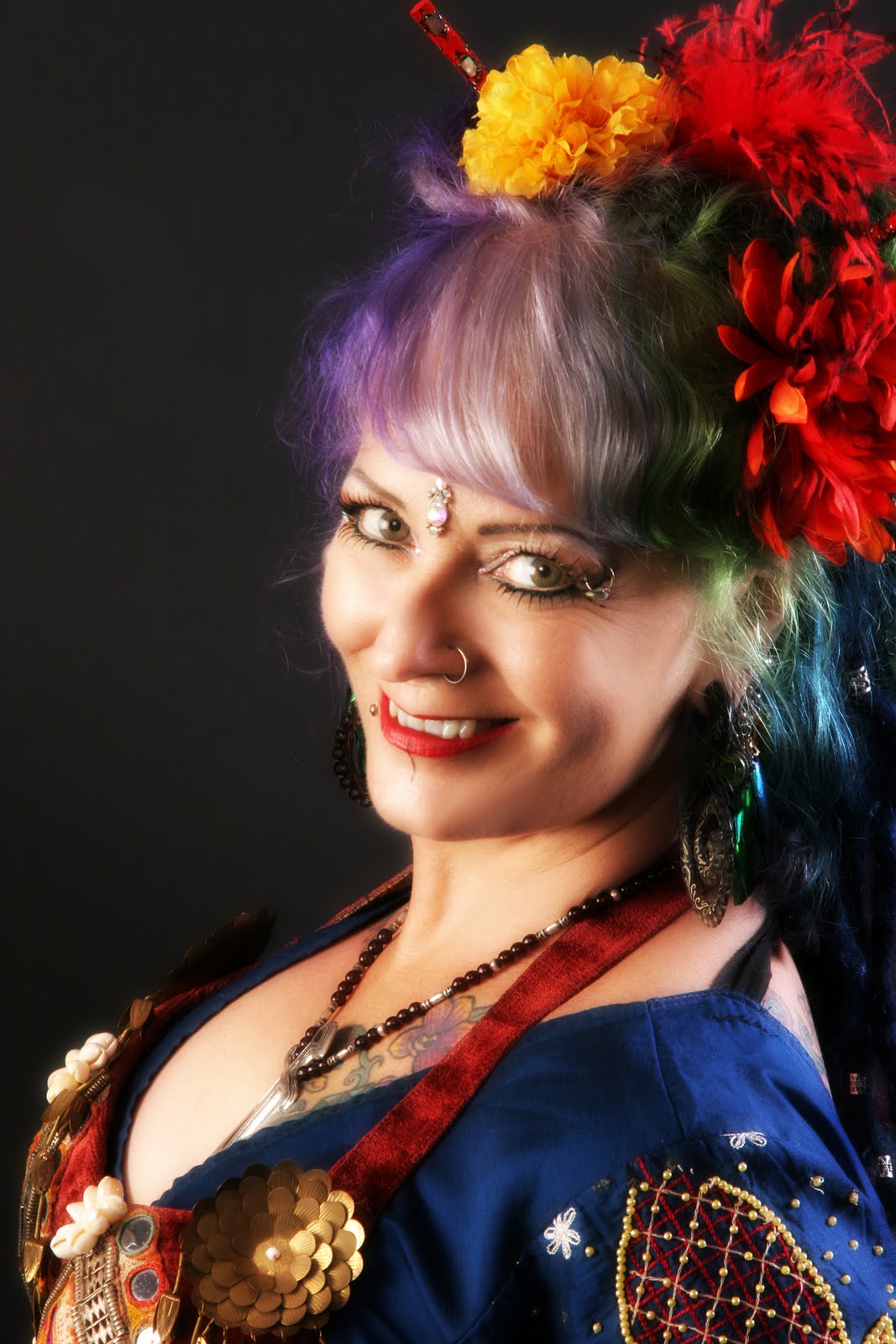
DANCERS BACKSTAGE RITUALS PART EIGHT: LISA ZAHIYA


Lisa Zahiya is one hot ticket!

An incredibly versatile and strong dancer, Lisa travels nationally to perform and teach traditional and contemporary belly dance ( incorporating many different styles!) as well as Bollywood, Bhangara, and hip hop. Based in Asheville, she also owns Studio Zahiya, and is on the faculty at the University Of North Carolina, where she teaches-you guessed it- dance.

I first met her at Onca O'Leary's ABSFEST 2007, and the next year was sitting on the judging panel at Belly Dance Of The Universe when she won the fusion competition, with a hawt Fosse-inspired number. Since then, she's won many more competitions and is getting lots of recognition for her fabulous work.

March 3 & 4, 2012 She will be teaching and performing in Pittsburgh, PA, and March 16 & 17 Lisa will be in Knoxville, Tennessee.

Here, in her own words, is how she prepares for her shows:


"When I put on my makeup I listen to a playlist called "songs I love" either at home or wherever I'm getting ready. I imagine that is the transformation from Lisa Newton (my legal name) to Lisa Zahiya. I use that time to put aside whatever is happening in my life and focus on what I'd like to do in the performance.

Right before I go on I take 5 deep breaths with my eyes closed and try to remove myself and my ego from my performance, I say thank you as gratitude for being able to perform and devote my life to this and then say "please allow me to do whatever this audience needs today." This makes me try to focus on who I am performing for and not myself..."

--LISA ZAHIYA

Monday, December 19, 2011

DANCERS BACKSTAGE RITUALS PART SEVEN: KAJIRA DJOUMAHNA


This is Part Seven in an on-going series of articles I am posting, which shares the ways that well known- and in some cases, wildly famous- dancers prepare for their shows.

Everyone I spoke with had a highly personal take on getting ready for taking the stage.

For most of you, Kajira Djoumahna needs no introduction. She is one of the queens of Tribal Belly dance, an innovator with an illustrious career that has been spanned over two decades and shows no signs of slowing down. Kajira’s the founder, creator and “Chief Imagineer” of The BlackSheep BellyDance format, and along with her husband Chuck, is the producer of Tribal Fest, the largest and longest-running Tribal belly dance festival in the world, which takes place every May in the beautiful Northern California town of Sebastopol. She is a writer, with a regular column for the belly dance magazine “Zaghareet”, but more importantly, she is the author of the definitive book on Tribal style belly dance, “The Tribal Bible”. As of 2010, “The Tribal Bible” has been through six printed editions. Kajira has many instructional and performance DVDs on the market, and teaches and performs all over the world.

Kajira and I have known each other pretty much since the beginning of both of our careers, at the dawn of the 1990’s. We met in a really crazy way, and became fast friends. Happily, the craziness never stopped.

Before I started belly dancing, I was a wild rock ‘n’ roll chick… some people in the dance community think I’m wild now… but suffice to say, they didn’t know me before! I was a Hollywood punk rock fixture. I recorded albums and toured all over with my all-girl band, The Screaming Sirens, I booked clubs in Los Angeles, and under my given name, Pleasant Gehman, wrote extensively about rock ‘n’ roll for many national and international publications. There was a little bit of crossover time between my two careers before I began devoting all my time to dancing.

So, how does this relate to Kajira?

About twenty or so years ago, I’d written a profile of Iggy Pop for a well-known rock magazine, and when the editor asked me for a photo for the Contributors Page, I sent a picture of myself in my belly dance costume. Weeks later, on one of my visits to the office, the editor told me the magazine had published a Letter To The Editor that a reader had sent in.

Handing me the original letter, he said with a somewhat perturbed look on his face,

“I’m not sure what “AIWA!” means…. but I think it’s good.”

Upon hearing the Arabic word for “yes” I was highly intrigued, and grabbed the letter, which was from…. you guessed it- Kajira!

I wish I still had that letter, but sadly, I don’t, so I’ll paraphrase it. Basically, it went something like this:

“ A big “AIWA!” on the Iggy Pop story- I can’t BELIEVE there is another belly dancer out there who is a writer, and who also loves rock and roll!”

Well, at this point I started hyperventilating- because I also couldn’t believe there was another belly dancer out there who loved rock ‘n’roll in general and specifically Iggy Pop!

You must remember that this was pre- internet, and before cell phones. At that time, most of the women that I met who were into belly dancing were doing it as a hobby, and were, like, suburban housewives- I knew I loved this dance and was already obsessed with it, but I didn’t have jack in common with the dancers I was meeting.

Also, a in those days, most of the places that were featuring belly dancing were Arabic clubs and restaurants- I had to cut off my dreads and dye my hair from punky rainbow stripes back to it’s original color, and hide my tattoos in order to be able to get dance work…as well as borrow “normal” clothes from my mother because I only owned stuff like leather mini-skirts and ripped fishnets, and you couldn’t wear that stuff to Arabic clubs!

I couldn’t believe there was a kindred soul out there…someone who also loved rock ‘n’roll, writing and belly dancing- I was hearing angels sing because I Wasn’t Alone!

I began hounding my editor to find the envelope that the letter had come in, so I could get the return address and write a letter back to this woman who shared my passions. Finally, he did.

A couple of days after I’d written her a letter, Kajira called me, and we stayed on the phone for ages, talking about our favorite bands, writing, and, of course, belly dancing.


Kajira had just started studying with FatChanceBellyDance founder Carolena Nericcio and was making the transition from cabaret style to Tribal. Meanwhile, I had been studying with a woman who had been a student of Jamilla Salimpour, and a chorus girl in Bal Anat. I’d been learning Jamilla’s folk-based Ren Faire style, but after my first trip to Cairo, was starting to get heavily into classical Egyptian dance.

Kajira and I started corresponding through snail mail, writing lengthy letters and sending each other costume pieces. She'll probably kill me for mentioning this, but she sent me a pink lace and gold lame ruffled cabaret skirt that she was no longer using, and I sent her a hand-embroidered Bedouin vest that I’d gotten on my first trip to Egypt…which I, having “gone cabaret” was no longer wearing.

Soon, Kajira called me and excitedly told me that she would be down in Southern California to do a workshop with the legendary Morocco in Anaheim. I was rehearsing for a show and couldn’t make the class, but we made arrangements for her to come up and spend the night at my house after the workshop was over.


I wound up taking her to my favorite Hollywood dive bar, The Blacklite, a place that not only had a great jukebox, really cheap and exceedingly strong cocktails, but also was populated mostly by tranny hookers! We drank boatloads of margaritas and I dimly remember buying a bunch of studded belts for, like, a dollar a piece from a bag lady that had wandered into the bar.


The rest is history- we stayed in touch and kept track of each other’s personal dance –paths and career progress. In 2005, she asked me to teach at Tribal Fest for the first time; in 2006, beginning at the MAJMA festival in Glastonbury, England, we started meeting up with each other at various workshops and events all over the world.

But maybe the most insane dance festival experience we shared actually took place at her own event! A couple of years ago, we hung out in an equipment closet (cause it was quiet and private) in the back of the Main Hall, at Tribal Fest, while Amy Sigil of Unmata was teaching, and shot the breeze, while Kajira was being interviewed for the belly dance magazine “The Chronicles”...while simultaneously getting tattooed by artist Natasha Vetlugin. Yes, just a “normal” day in the life of Kajira Djoumahna!

Anyway, this is what my longtime friend - and globally acclaimed dance figure- Kajira has to say about the way she prepares for her shows:


“ As I put on my costume and makeup, I start my backstage process. Even if I'm still at home looking into my own mirror, I am now "backstage". If I hadn't become my stage name by now in all of my life, I would "become" it at this point; as I don my makeup I also don my persona. I become larger than life, I take on a new idea of myself as I transform my physical look.

At my destination (assuming I got ready at home or a hotel) I put on my finishing touches close to the time of my performance. These consist of my belt, lipstick, sometimes Paws or other dance shoes, and heavy tribal bracelets. Once fully adorned, I stretch and breathe and ready my finger cymbals for a quick put-on.

After my cymbals are on my hands and the time is even shorter, I always do a backstage centering meditation in the form of an East Indian pranam, or "puja for the stage". My personal pranam (also known as a prayer, moving meditation or centering exercise) is a variation of my teacher's. Everyone in my classes learn this as well, as it serves to set apart sacred time from mundane and it really works to help change focus and bring one into the "now".

My "prep" is still not over, whether I'm performing with BlackSheep BellyDance or solo! Once on stage, I almost always make a circle when I enter to help me "claim" my space and set it aside in my mind from anywhere else. If I cannot make a circuit because of my style or choreography that day, I do so in my mind to delineate my space from everyone else’s.

Now fully prepared, I lose myself in the moment and just dance!"

-KAJIRA DJOUMAHNA


Kajira & Black Sheep Belly Dance: http://www.blacksheepbellydance.com/home.html

Tribal Fest 12: The Year Of The Unicorn:
http://www.blacksheepbellydance.com/tf12/


PHOTOS: KAJIRA BY VICTORIA WEBB; KAJIRA, PRINCESS FARHANA & LEE ALI at BELLY DANCER OF THE UNIVERSE

Saturday, January 9, 2010

RAQQIN' THE RETRO: VINTAGE BELLY DANCE COSTUME CARE AND REPAIR


Vintage belly dance costumes and antique stage accessories are a personal passion of mine …to look at, to own and to wear. Fascinating in their staggering variety, they can run the gamut from clumsily constructed home-made affairs to Egyptian, Lebanese and Turkish couture costumes, to ethnic pieces that were not made for stage use, but to be worn as real clothing, for every day use or as ceremonial or bridal wear.

Many of the most well-known belly dance costume designers have been in business for years, and like top street clothes designers, have had different designs concepts and in many cases, full collections for every season. Older Oriental dance costumes were made by hand, and constructed to last literally, a lifetime. Of course, there have always been the cheapie ‘airport special’ costumes, basically souvenirs for tourists- but even those used to be constructed much better than they are now!

More recently, there has been an explosion in belly dance costuming, due to the sheer demand for it as the world-wide popularity of belly dancing grows, as well as the age-old concept of “making a buck”. There is now a wide mid-range of costumes that is not couture, but lacking in the detail and construction of higher-end pieces. Kind of like the stuff you’d find in a designer knock-off shop, which highlights trends, but does not offer quality. This takes many faces- the stones may now be acrylic instead of crystal- and glued on as opposed to sewn on; beading and fringe are done with less workmanship and inferior threads; sizing may be off, etc.

As with vintage designer clothing, most of the professionally made older costumes are fabricated with much more care than their counterparts today. Compare this trend to what’s happening in the world of retail clothing, or even cars, house wares, electronics, heck, you name it… mass production has it’s drawbacks! Though it makes items affordable, the quality in design and craftsmanship is not usually there.

Lately there has even been a trend among belly dancers to return to the glamour and over-the-top design of the older style costumes…. fringe dripping from every possible area on the item. It’s no secret that many older items of belly dance costuming can be had for a song and be made beautiful and serviceable again, through a little loving care.

If you are planning on washing a vintage belly dance costume, or a costume that has been fabricated from antique textiles, mirrored fabric, or one that is hung with heavy coins proceed with care. Many older cabaret costumes were never stored properly-or ever washed, for that matter- and because of the accumulation of sweat or skin oils from the previous owner(s) as well as fabric deterioration due to normal wear and tear or in some cases, exposure to sunlight, the fabric itself may be compromised, and this is especially true of velvets and brocades.

Older professionally made costumes from Egypt, Syria and Lebanon, even after a number of years, are almost indestructible. This is great because they withstand the test of time, but in some cases, the costumes were constructed of so many layers of heavy, thick materials that they may be nearly impossible to alter- even getting a needle through them is tough. And because of the copious amounts of beading, anyone intending to cut into or remove parts of the costume needs to be a cracker jack at re-beading so that the alteration matches the rest of the costume. Lebanese and Syrian costumes especially used a lot of chunky beads and big pearls on the fringe- and if fringe is missing in spots, it may be impossible to find an exact match. You will either have to bead your own with similar-looking beads or replace it entirely. Older synthetic pearls have chipped or flaked or lost their luster, due to shaking and rattling against each other. You can actually paint them with nail polish to make them look new again, but this is a very lengthy and intricate process.

Vintage Turkish costumes are also tricky to restore- many had wires inserted into the tops of bra or on the belts, to reinforce shapes, and these wires may have rusted or poked through the material that anchored them. Turkish fringe, through beautiful in appearance, was never constructed as well or as sturdy as it’s Egyptian counter-part, and may have to be replaced. Turkish costumes from the 1950’s- 1970’s were very fragile, hand-beaded and with many cut-outs, including cut-outs on the brassieres that, as the style of the day dictated, were totally open to show the skin! This spider-web effect is stunning, but because there are no actual bra cups, just an overlay of beads meant to be worn against the breast, they may be impossible to salvage, unless the entire piece is cut apart and carefully placed over a bra-cup.

Non-professionally-made vintage cabaret costumes were often made by hand, with the bra constructed from a regular lingerie bra. This is not to say that some of the homemade jobs weren’t spectacular, or well made. Many of them are simply amazing. But once ten to forty years go by, the older fabric of the base-bra itself may be breaking down and losing its shape. Appliqué designs may be fraying or coming off; coins may be missing due to wear and tear on the threads that fastened them, metal snaps, hooks and closures may be rusted, and the costume’s straps my be stretched out or actually coming off the costume. These older costumes were often hand-beaded by dancer who wore them, and sometimes the beads, fringe and loops were not knotted securely, or the knots themselves have frayed due to time. In many cases, if one piece of fringe falls apart, it will create a chain reaction in the entire row of fringe. Older sequins may have lost their color and sheen and have a clear appearance; some decorative crystal stones may be missing.

As for custom made ethnic or Tribal costumes, many of the fabrics used in their construction are serious antiques. Dancers hunt far and wide for textile treasures to make their costumes special, and though some of the fabric finds are still gorgeous, they are very fragile. Even older cotton pieces may be delicate in condition and have some dry rot, especially if the material was exposed to the sun, dust or elements- think pieces originally used by nomadic desert-based tribes like Berbers, Kuchi or Bedouins. Also, the more lavishly a piece of older material was decorated with embroidery, variously applied metallic strips, buttons, mirrors, or sewn-on appliqués, the weaker it will be, due to age and deterioration of the fibers. This is especially true of antique Assuit, a traditional Egyptian hand-made cotton mesh fabric embellished with designs created from small strips of real silver hammered by hand into the mesh. Coming from the Egyptian village of the same name, the new Assuit is mostly mesh fabric, with silver designs, while the older type of Assuit was mostly hammered silver (with the designs left in the color of the mesh) which made it extremely heavy. Lengths of vintage Assuit are usually astronomically expensive, because the sheer mesh base fabric has become so heavy from the silver decorations, it is prone to rips and tears, plus the fact that as the silver oxidizes due to age, which also can weaken the base fabric.

Other vintage ethnic textiles may have been constructed by hand, embroidered with metallic threads, and large beads or pearls; or hung with decorative shells, beads, bottle caps, buttons, small mirrors or bells, all of which will weaken the fabric due to weight. Many ethnic fabrics were woven by hand or embroidered with material threads that were not commercially dyed, and therefore are not colorfast.

Dry cleaning for antique pieces is NOT recommended- however; careful hand washing, in most cases, should be OK. Make sure to use lukewarm water, and a very mild soap. I myself use baby shampoo. When rinsing, do it thoroughly- any soap residue left in the garment will put the natural deterioration process on fast-forward. When drying your costume or costume piece, roll and pat the item carefully in a towel, then lay it flat to air dry on a fluffy towel. Do not hang it up or the fabric may stretch out; never put it in a dryer, the heat and tumbling action is the kiss of death!

Have a serious look at your antique or vintage costume pieces, maybe do some research on the Internet or ask a costumer or antiques dealer if you can and try to assess the fabrics used on your costume, it’s age and durability. You may ultimately opt not to wash them.

If you have a costume decorated with coins that have tarnished and you want them shiny again, you can clean them individually with jewelry polish (not commercial brass or silver cleaner) applied with a Q-Tip. This is a painstaking process, but will shine up the coins and if you apply the polish carefully, will not stain the rest of your costume. If the coins are sewed on in rows, you can take a piece of heavy paper or cut a length of plastic off a shopping bag, lay it underneath the row of coins, and polish them that way, protecting the material they were mounted on. This works well for both real coins, and manufactured costuming or trimming coins.

Actually, a handy trick I learned from an antique dealer who dealt in estate jewelry is to clean any older items using plain old toothpaste, as opposed to any sort of polish. This works much better for rhinestones and crystals- I use it on all my antique tiaras…and believe me, I own a lot of them!

It works just as well for jewelry made of pot metals or “paste” (vintage faux jewelry) as well as Kuchi jewels or ethnic items made from low-quality silver or mixed=metal alloys. The toothpaste is less acidic and much less abrasive than even jewelry polish, and will remove dirt or tarnish without damaging the patina of the item. I usually apply the toothpaste by hand and gently rub it with my fingers, but you could also use a soft child’s toothbrush to do this. After you’ve shined up the item, rinse it off with tepid water, and pat it dry with a soft cloth.

Care for your vintage costumes and accessories properly and lovingly, and should be able to restore them to their previous beauty, as well as raq them proudly onstage!

Pictured: A 1960's era Turkish costume bra, owned by Zahra Zuhair. This bra was constructed by hand, of glass bugle beads, with the neck-halter made of bugle beads hand sewn onto a thin length of grosgrain ribbon. The bra cups are made totally of beads, it was the Turkish style for these to be worn over bare skin.

Saturday, April 18, 2009

TRIBAL ADJACENT


I may be one of the most glitter-addicted, rhinestone-afflicted, bring-on-the-bling belly dancers on the face of the planet. I was trained extensively ( in the USA and Cairo) in the neo-classical Egyptian raqs sharqi style. I have absolutely no background whatsoever in ATS, ITS, or just plain old Tribal belly dance. But for the past few years , roughly half of the events where I’ve taught workshops, performed, and judged competitions are Tribal and Alternative dance festivals . Many dancers wonder how- and why- this came to be.

My professional belly dance career began in 1991. Enchanted by the dance in all it’s forms, whether Egyptian, American Cabaret, Turkish, North African folkloric, Rom, Persian- you name it, I studied it. I took classes and workshops, saw as many dancers as I could ( both live and on video) and did as much research as possible in those days, long before the Internet made that part easier. I was obsessed! At that time, Oriental dance was in a kind of limbo state. The first Gulf War was going on, and anti-Arab sentiment was strong in this country. The huge belly dance fad that had swept the nation in the Eighties had died down, and the art was only being kept alive by a few die-hards- wonderful, experienced women who’d been teaching and performing professionally for years, and a small handful of enthusiasts who were mostly ( in Los Angeles, at least) housewives.

I stuck out like a sore thumb: I was a tattooed and pierced rock and roll chick with bleach- striped dreadlocks who wanted to be Fifi Abdo….Whaaaaaaat?

Nowadays, that doesn’t seem so weird, but back then, well, let’s just say I was an anomaly! My tattoos were always hidden when I performed nobody knew I had them. I had to borrow my mom’s clothes to go to Arabic clubs, because all I owned were leather mini skirts and ripped fishnets….and any money I had was going directly towards Egyptian costumes, so I could live my crazy dream!

Back then, there was really no such thing as alternative belly dancing, at least not in the massive way there is today. I wanted to experiment with my newly-beloved art form, and make it completely over-the-top and dramatic.

I had literally grown up in the theater. Dad was an entertainment writer, mom was an ex-chorus girl, dancer and singer who worked in the theater department of an Ivy League school, and directed musical comedy when I was a kid. It being the late Sixties and early Seventies, while I was in my formative years, I got the education of a lifetime on that campus! Let’s just say I was no stranger to outré, experimental dance forms. But there was no outlet for me to do this in my chosen discipline: Oriental dance. Whenever I mentioned my cockamamie ideas ( like raks shamadan to the Door’s song “Light My Fire”, or doing an homage performance to Mata Hari ) other dancers seemed to think I was just plain crazy. But I had know- how about putting on shows, and began to use it.

In 1993, I co-wrote, directed and performed in a show called “Common Threads: Women And Oriental Dance”, which had two sold-out runs at LA’s Highways Theater, and was later tapped for MECDA’s Cairo Carnivale evening show. It featured cabaret and folkloric styles of belly dance, acting, spoken word voice overs, and many numbers that were pure fantasy, and would now be known as Fusion. The cast included Zahra Zuhair, Sahra Saeeda, Anaheed, and a then- up and coming performer, Jillina.

Around that time, I saw Fat Chance Belly Dance at a tattoo convention, and was blown away. I remember thinking, “If I ever move to San Francisco I should join up with those gals!”

Coincidentally, at that time, I began a correspondence ( through the US Mail, thank you very much!) with a student of Carolena Nericchio’s, and we got on like gangbusters because we both couldn’t believe there was another person who loved belly dance as much as punk rock…and we were both writers! Talk about sympatico! Her name was Kajira Djoumahna. We stayed in touch and visited with each other for years.

As belly dance began to change with the advent of the Internet and more access to knowledge, World Music and fused musical forms began to get very popular. I believe it was Alabina’s first recordings in the mid-to-late Nineties that took the Arabic dance world by storm, prompting a mania for Flamenco Arabic Fusion. After that, the doors blew wide open. As time rolled on, there began to be more and more performance avenues for me to perform my “crazy experiments”, which I did, with passion. By the turn of the last century, I was regularly performing adventurous pieces ( some of which became quite controversial) and many others were, too. Tribal belly dance had exploded, and dancers were beginning to have myriad outlets for their own creativity within the context of the dance.

In the “olden days”, belly dance seemed to be divided into two distinct camps: Egyptian and Turkish…and many times those factions seemed to be at war over which was better or more “legit”, similar to the neurotic division of sentiments towards Los Angeles vs. New York City, or Classical Music vs. Rock ‘N’ Roll. After a while, the teams became “Cabaret” and “Tribal”, each side with vehement supporters, many of whom dissed the other practice. This seemed strange to me, since I admired both forms, but many dancers seemed to take sides steadfastly.

When Kajira Djoumahna first asked me to teach at Tribal Fest Four (May 2004) many people were astounded. Even I myself wondered what would happen when I went up there- how would I be received? But it was Kajira’s idea and she was confident in her motives, and adamant that I teach. I even had to make a costume specially for the festival, because everything I owned was covered in rhinestones and fringe, and there was a strict costuming “dress code”. I remember my class gasping in surprise when I removed my sweater, revealing my tattoos… how was it possible that a cabaret dancer could be covered in ink? The whole thing was a bit controversial: I wasn’t pretending to be Tribal, I was straight-up Cabaret. Some Tribal dancers were skeptical that they would be able to learn anything from a Cabaret performer, and almost felt violated that there was an “outsider” among them. Many Cabaret dancers felt like I’d betrayed them and shamelessly “gone to the other side”-it was almost like a belly dance version of “West Side Story”!

Nevertheless, as an experiment, it was a success, and I have been asked back to teach there every year since then, which has lead to my teaching at a number of other Tribal festivals. Always insightful, Kajira insisted I would become a belly dance version of what the music industry refers to as a “crossover artist”, and I did. Other early supporters of my trans-genre work were Tempest, and the women of the troupe Devadasi , now Blue Damsel.

I love Tribal style for many reasons: it’s mesmerizing and a joy to watch, of course, and there are many amazing artists in the field, many of whom are now close personal friends. But probably the main reason I love working at Tribal festivals is that there is a sense of daring and adventure that is not always present with practitioners of Cabaret style dance. Personally, I attribute this to Tribal style being an American invention: the dancers do not have to live up to a certain traditional, ethnic standard in performance, costuming and behavior, and so they feel free to play around, letting their own unique personalities and frame of reference inform their work.

Conversely, I believe that I have given many Tribal dancers an inspiration to explore theatrical presentation as well as traditional cabaret stylings such as veil work, fan dancing, Egyptian technique, not to mention get in touch with their inner Glamour Puss, through burlesque. Though my years of activity in the field of burlesque has long caused raging debates ( and yeah, a lot more controversy) with Cabaret dancers , Team Tribal embraces the genre as the art form that it is.

Initially, I used to joke that I was going to “pollute” the Tribal world with my love of glitter and glitz. I couldn’t see why there was such widespread distaste for anything sparkly or shiny.

I even had a concept: On any continent, at any time in history, if a bag of Egyptian fringe and rhinestones were dropped into the midst of a group of Indigenous Tribal Peoples, are you gonna tell me they weren’t gonna use it to adorn themselves?! HELLO- we’re talking about folks who would sew smashed bottle caps onto their clothes and adorn their hairdos with zippers! A couple of years ago, Rachel Lazarus Soto came up to me and gleefully reported that she’s been picking all the glass out of her antique Afghani jewelry and replacing it Swarovsky crystals…and now many other dancers are following suit!

When I teach abroad, there doesn’t seem to be as much of a divide between the two belly dance genres , and even here, thankfully, that is now changing. Cabaret and ethnic folkloric dancers regularly teach at Tribal festivals; events that were previously Cabaret-only have come to welcome ATS, Fusion and Alternative dancers, and many brand-new events dedicated to the Alternative ( like California’s Hips Of Fury or Arabia Exotica,Tribal Throwdown, or Philadelphia’s Fuze Fest) have recently sprung up.

We are in the midst of a bona fide belly dance boom- and performers of all stripes are heading up the revolution! Whether Tribaret, Raks Gothique, Belly-Burlesque Fusion, Asian-Arabic, Bollywood Fusion or just plain old Cabaret and Tribal…we are all united in dance, and that is truly something to kick up your heels about!

** Pictured: A Kookie Kaftan sandwhich: me with Lynne and Julie Chapman, two of my favorite dancers in the UK. We're wearing shirts that Lynne's hubby Alan designed. Cute, no?