Thursday, October 8, 2009

LONDON CALLING


Once again I am off to my home-away-from home, London... this time for the world premiere of "Stuck!", Steve Balderson's homage to vintage women-in-prison movies. "Stuck!" will be screening for the first time ever at Raindance Film Festival, the largest Indie Film festival in Europe, showing at the Apollo Cinema in London, near Piccadilly Circus, on Saturday October 10th.

I am so excited for the premiere, but also a little nervous, as are the other women in the cast...because we haven't seen the movie yet!

The past month has been spent at home- pretty rare for me these days! It has been great to have a break from travel...I have been working on new choreographies and costumes, re-bonding with my boyfriend and cats, teaching local classes and workshops, writing and reading a lot, mostly dance biographies.

After the UK, I will be attending another film festival- The Tall Grass Film Festival, in Wichita, Kansas where "Underbelly: A Year in The Life Of Princess Farhana" will screen on Saturday, October 24th. I will perform directly after the film at The Orpheum Theater on October 24.

I will also be teaching workshops at Amira Dance Productions in Wichita on October 24 & 25th, contact Terri Dirks for info: dahabeya@hotmail.com

Bon Voyage!

Monday, September 28, 2009

RAQ THE RECESSION-BELLY DANCE ON A BUDGET


People all over the globe, in every income bracket, are feeling the effects of the failing global economy… and belly dancers are no different! The belly dance world has been experiencing the fallout of this recession just like everyone else. Un-employment is high, and many are losing jobs. People are cutting back on necessities, not to mention luxuries and leisure expenditures. In general, it seems that belly dance students are attending less classes , and in turn, studios and instructors are experiencing lower overall attendance, which means less income. Restaurants and clubs have cut back on nights featuring live entertainers- belly dancers and musicians. Across the board, belly dance suppliers and vendors have noticed a drop in belly dance costume, prop, DVD and CD sales. Merchants are complaining about having less buyers, and buyers themselves are frustrated that they can no longer afford “luxuries” like belly dance costumes, DVD’s, and the like.

Yes, our county’s financial situation is dire, but there are things we can all do to make sure we can keep our careers, favorite hobby or dance practice alive. Sometimes, it just requires a little monetary juggling or re-thinking where and on what you are spending.

When I first began dancing almost twenty years ago, I was in a rock ‘n’ roll band, already leading the life of a “starving artist”… in other words, I was flat broke! Out of necessity, I had to get really creative about the ways I was going about moving my dance career forward, and figure out means for taking classes, getting myself costumed, and promoting myself. It was always a scramble to do this on a practically non-existant budget, but somehow I made it happen.
Recently, I began to recall all of the things I did “ back in the day”- my tricks for cutting corners and being able to afford music and costumes so I could do to achieve my goals… and I thought perhaps some of this might help other dancers get through these financially tough times, so here are some ideas.

USE THE BARTER SYSTEM
There are many things you can “afford” by using barter or trade, and that includes your continuing dance education! Ask your local studio if you can trade some volunteer time in exchange for classes…maybe you can offer to tidy up the studio, or sit at the desk to take attendance for regular classes or workshops, or do office/ administrative work in exchange for classes.
Want a private class but can’t afford one? Think of what you could offer your teacher. If you have a skill, it could be a straight exchange: are you a photographer, make-up artist, seamstress or web designer? Any of these talents could be traded for belly dance lessons. Or perhaps you speak French, or are good at gardening, book keeping, child-care- whatever! Think of the skill set you have and see if they could possibly be performed in exchange for private dance lessons.

Make a Dance Play Date with a friend. This is like a private lesson, essentially: two dancers get together and figure out what they want to learn from each other, book an hour or two of rehearsal time in a studio (or just get together at someone’s house) and give each other a private lesson in each other’s specialties, say sword technique for fan tips, Hip Hop or jazz dance know-how in exchange for a Saidi choreography, even a Cabaret and Tribal movement swap. We all have skills and talents that we want to learn or wouldn’t mind sharing. Just ask!

POOL RESOURCES
Carpool to classes- enough said! This saves on gas and gives everyone a chance to socialize and hang out, too. You can also car-pool to major dance events, and for road trips, of course, share hotel rooms. Bring along cooler or two and save some dough by bringing along your own water, snacks and munchies. This is usually healthier-and way less expensive- than buying food on-site at dance events.

Many instructors are happy to give private lessons to two students at a time, or even a small group, for the same price that a single person would pay. Ask around about it and you might be able to get private instruction for less than the cost of a regular class.

Combine printing and promo costs. Say you and a friend both want business cards- print them double-sided (one dancer per side) and split the cost down the middle. If you have an event coming up that is fairly close to another scheduled event, contact the other promoter and see if there is a way to cut promotional costs by sharing a website, graphic designer or by printing up both events on one flyer or post card. This will reduce your expenses, and also open you and the other person up to a whole new range of potential students, business contacts, or ticket-buyers.

Share props and costumes with your trusted friends. Own a shamadan but need some fan veils for an up-coming performance? See if anyone would be interested in a temporary prop-swap…this would save you having to buy the props if you are only going to use them a couple of times.
If you are ordering a set of Isis Wings in silver, see if someone else in your area has them in gold (or red, or whatever) and ask if she would be willing to trade them on a per-performance basis, so they could be used by each of you with more than just one costume…and you wouldn’t have to spend on two sets of wings! Or, you and a pal or two could go in together on buying an expensive costume or prop, and decide who gets to use it and when. Some friends and I were all going to buy expensive Sally Rand Ostrich plume fans, and before buying them, we all co-coordinated who ordered what color so we could interchange them for various shows based upon our individual costume needs.

As someone who makes a living from teaching dancing both live and on DVD, I don’t at all advocate illegal copying of any DVD’s or CD’s… but I do think it’s perfectly fair for individuals to buy instructional or performance DVD’s and CD’s and share them with each other. Either swap your DVD’s after a few viewings or have a “workshop” day or “DVD party” at your house and invite a couple of dance pals over to view the latest instructional or performance DVD.

EXTEND THE LIFE OF YOUR COSTUMES AND PROPS
Make sure to take care of all your costumes and props, keeping them clean, repaired and in working condition. This will help not only in extending the “life span” of whatever you own, but should you decide to sell it, it will keep the re-sale value of the item higher.
Hand-wash your work-out and class wear- this will not only save on energy and electricity bills, but the garments will last longer, because the color and fabric fibers get broken down in the clothes dryer.
Belly dance costumes can also be hand-washed , too, and a clean costume will definitely last longer. Many dancers are afraid to try it, but do a spot test first, to make sure the color won’t run. To wash your costume, fill a bathtub about a quarter full with cool water and a very mild hand-washing dtergent, like Coollove or Woolite. I myself use baby shampoo. Just swish the costume around a little, rinse very well, and lay it flat somewhere safe to dry. On highly embellished costumes, this may take up to a few days, but the costume –and it’s fringe-will sparkle like new.

Think of ways you could re-work older costumes to make them new and fresh again. Replacing worn-out fringe - or even taking fringe off completely- can make it look new again, and costs much less than buying a new one! Gather up all your un-used veils and sew them into a full gypsy skirt… if you have a costume with sleeves, see if they can be removed and made into gauntlets… try dying older or stained veils- most dye well, and the sequins will retain their original color…mix and match the costume pieces you already have and see if you can come up with new ways to wear them.
Get your wigs and falls re-styled instead of buying new ones. This will not only prolong their life-span, but is much less expensive.
Re-sole your suede-soled dance shoes with a thin layer of “dance rubber”- this will extend the life of the shoes as well as protect your feet.

BE FRUGAL
Sort through your costumes mercilessly and figure out what you can part with. Sell old items or those that never fit quite right on the Internet, or in your local dance studio. You can definitely “find” some money this way- or be suddenly able to afford a new costume.
Organize a costume; accessory and prop swap with your dance friends- one dancer’s trash is another gal’s treasure!
Shop at second-hand stores for old evening dresses or accessories that can be used to make or enhance costumes. Take a hard look at what you own, or what you want or need, and figure out a way to get it, either by making it, or incorporating it in some way…like cutting off appliqués from a brides maid dress you bought at a garage sale!
Ask your local dance studio or gym if they have a discount “class card” or will offer a special price on a block of classes paid in advance. Many studios and gyms do this already.
If you are professional dancer, you might already know that larger companies like Capezio or Mac Cosmetics offer a substantial professional discount if you present a business card, or register into a “Pro” program. Work this option, girl!

Many on-line vendors have a mailing list you can sign onto that will notify regular customers of costume and prop sales- sign up and save some serious greenbacks! As for festival vendors, if you are coveting a pricey costume you can always have a word with the vendor about your purchasing options- some vendors may reduce the item’s price after a few months, or be willing to charge less if you pay in cash, or will put it on lay-away for you.
Explore ordering belly dance supplies whole sale. You and a few friends want new hip scarves, CD’s or need finger cymbals? Contact vendors and see if it’s possible to get a wholesale price on an order with multiple pieces.

THINK “GREEN”
If you have dance items, props, craft supplies or even old materials or trims you are not using, consider donating them to a student dance troupe, local theater companies, drama classes, kid’s day camps or even women’s centers. It will not only clear out your closet, you will have the great satisfaction of knowing that someone will be getting some good use out of whatever you don’t need!
Above all, don’t let the bad economy prevent you from doing something you love! Have fun, get creative and keep belly dancing! The world- no matter what the financial climate- will be a better place because of you!

Wednesday, September 16, 2009

CROWNING GLORY: CONSTRUCTING HEADRESSES AND CROWNS


Over the years, many people have wondered about my stage name, Princess Farhana. Reactions to my royal moniker have run the gamut from those who “get” it, to people who are confused or once in a while, even outraged. Many individuals show tongue-in-cheek deference and call me “Your Majesty”, or “Your Highness”.

Sometimes when I was teach and perform in Europe and the UK, where there are people who are true royalty, dancers earnestly and politely asked my sponsors if they should refer to me by my “title”. I even recall a review of a an early video performance of mine where the mean-spirited writer not only dissed my dancing but seemed to be downright disgusted that my name was Princess Farhana. I should have taken a cue from my royal sister Marie Antoinette and told her to go eat cake!

The truth is, when I started dancing, I was just plain old Farhana. But like an ancient legend, my royal title was bestowed upon me; the “fairy-godmother” who started calling me Princess Farhana was the dancer Atlantis. Her reason? The fact that I wore my trademark crown or tiara every time I performed. Like many nicknames, it stuck immediately!

Before I even set foot onstage, I had a crazy, big-ass collection of crowns and tiaras, ranging from vintage beauty queen numbers I’d found at flea markets to plastic kid’s tiaras with blinking LED lights to cheesy “Halloween Headquarters” Cleopatra-style Egyptian cobra-crowns to Victorian –through- 1920’s headpieces glittering with semi-precious stones purchased (sometimes for budget-breaking sums) from auctions and estate sales. I was an addict! It got to the point that rhinestone tiaras were simply not enough, I needed CROWNS. Then, in total junkie mode, crowns were not enough and I needed full-on headdresses. I soon realized that merely wishing for royal headgear wasn’t going to make it a reality… so I got out my craft supplies and started to play.

After a lot of experimenting, I got pretty good at fabricating fabulous head pieces… so here are a few ideas and tips for doing it yourself. You will need some or all of the following materials, many of which can be purchased inexpensively at craft or sewing stores, or even- if you are a crazy crafts/costume hoarder like me- found around your home. Here’s what you’ll need: a glue gun and glue sticks, craft glue, glitter, a yard or two of 1” elastic, rhinestones, artificial flowers, Mardi Gras beads or pearls-by-the-yard, feather plumes, sequin appliqués, and scraps of decorative material, such as brocade, sequin-dot fabric, or lame’. Get a couple of cheap plastic headbands – Goody, Scunci or any dime store brand is fine. Also- have a Styrofoam wig-head on hand, they are invaluable for the crafting of your headpiece, and the perfect place to store crowns and headdresses.

Coquette Feather Spray:
This cute headpiece is like one that a can-can dancer or saloon girl would wear, and is an awesome topper for cabaret, tribal, Goth or burlesque style dance costumes. Place a headband securely onto a wig-head, and with your glue gun, draw a line down the center of surface of the headband, thinly and evenly, then press sequin trim or decorative ribbon down on the line, turning the ends of the trim under at each end of the headband. Wait a few minutes for the glue to set, and then squirt a healthy blob onto one end of the band, the part that goes over and behind your ear. Press a feather plume or two into the glue. When the feather is stable, squirt more hot glue onto the “join” of the feather and headband, and cover it with glitter or rhinestones, which will cover any excess glue as well as look adorable!

Tiaras
The difference between crowns and tiaras is that crowns encircle your head, and tiaras are U-shaped, affixed to your head at each end, behind the ears, for dance-worthy tiaras, it’s a good idea to secure the headpiece with elastic from end-to-end. You may want to buy a couple of a pre-made tiara forms, which are basically wire-framed buckram or net crowns, available from most bridal shops or on the Internet. These range in price from about $5.00-$15.00, and make wonderful bases for embellishment, as well as save you some time in fabrication. If you get one of these, they usually have a covered wire attached from end to end. You can either leave it on, or snip it off with a craft scissors or wire cutter, and affix elastic either to each end by hand-sewing it with sturdy thread or dental floss. If your hair is dark, use dark elastic, so that it matches your hair.

You can cover the tiara form with decorative material (trace the tiara, c and cut the material a little larger so you can fold back the edges for more coverage. An easier option would be to lightly spray the tiara form with regular spray paint (from a hardware store) to match your costume. After it has dried thoroughly, and affix sequin appliqués or faux flowers to the front of the crown with a glue gun. You may also want to line the top edge of the tiara with sequins-by-the-yard trim or grosgrain ribbon, to give it a finished look. Make certain to turn the ends under, so they do not fray.

Headresses
To fabricate a headdress, begin by measuring your head from ear-to-ear across the top, and using a plastic headband for a guide, draw a curved crown shape on a sturdy piece of cardboard… any stiff cardboard is fine- I’ve used everything from (oh, the GLAMOUR!!!) water bottle or beer boxes to mailing cartons from the recycling bin! Cut the shape from the cardboard with a sturdy scissors. You may need a couple of tries to get a good shape that fits your head snugly. You may also have the crown rounded or with a point in the middle, at the top- your choice. Personally, I like the ends to be about 1-2” in size, and the mid-point, or top of the crown, about 3-5”. Once you have a shape that works for you, fits your head and is the height you want, trace it, and cut out another identical shape. To embellish, you can either spray the crown-shapes again, or lay them flat on a two scraps of decorative cloth, tracing out the design on the cloth with about an inch to spare. After you’ve cut out the shapes on your material, lay each of the cardboard crowns on both of the pieces of cloth, and glue them down by folding the cloth over the edges, and securing with a glue gun.

Next, place one crown-shape with the decorated side down, take your feather plumes, and lay them out on the wrong side of the crown, end-points down (you may need to trim them a bit from the bottom) on the crown. An uneven number is best for this, so start from the center, and place the other plumes on each side of the center plume. Measure for even spacing, mark with a pencil, and using your glue gun, trace the lines you’ve marked, with a good amount of glue, and press the feathers into the glue. Let this dry, try it on, and measure a length of elastic (white or flesh tone is best) from ear-to-ear, with about an inch left over on each side. This will be your headdress chinstrap, so make sure it’s a tight fit, but not so tight that it will strangle you! Again, with the glue gun, squirt a healthy dollop on one end of the headdress, at the bottom, on the wrong side (the side you’ve affixed the feathers to) and glue down the excess elastic. Making sure the elastic is straight; repeat this step on the other side.

Now, take the other crown-shape, and its wrong side, cover the entire surface with hot glue. Making sure it is laying evenly on top of the first form you made, press it down like a headdress-sandwich onto the feathers, so that they are held between the two layers of crown-shapes. After it has dried, you may want to make sure that top ends of the headdress-crown or held together in a sturdy way, and add a little glue for re-enforcement, being careful not to get any of the goo on the feathers.

Make sure to practice your dancing with the headdress or tiara a lot before you hit the stage- because the added height can throw you off a bit. Turns will also have a different feel, because of the height and resistance-factor, and some moves, like head-tosses, may be impossible! Also, warm up your neck and shoulders properly, because if you don’t, even that little bit of extra weight on your head may cause some discomfort the next day.

Have fun being a dancing diva!!!!


*Photo by Don Spiro

Monday, September 7, 2009

FROM ISIS WINGS TO ANGEL WINGS: BELLY DANCING AT FUND RAISERS


It's barely the end of summer, and in some places, school isn't even in session... but already, the stores are filled with Halloween decorations, and you know that means: we're sliding down a slippery slope to the end of 2009, and The Holidays. For some people, that means going into a purchasing frenzy. But with the economy being the way it is today, many of us may not be able to afford to spend the way we previously did on the gifts, feasts, bells and whistles that go along with the Holidays. So why not get your Jolly Holiday fix for 2009 by helping others?

Have you ever wanted to contribute to a worthy cause, but couldn’t seem find the time to volunteer, or realized that any “disposable income” you might have went directly to dance classes or costume purchases? There's a way you can help, and it doesn't cost a penny. Dancing at benefits and fund-raising events for charities, social or environmental organizations can be a great way for you to contribute to the worthy cause of your choice AND display your dance talent.

My entire adult life I have been involved in the arts, and though that has been unbelievably rewarding on a personal as well as creative level, I can tell you sincerely that “starving artist” is not a euphemistic phrase. Sometimes, over the years, even donating ten or twenty bucks to a great cause that I believed in would’ve broken my bank, so whenever I could, I donated what I could: my time and talent - both as an entertainer and an event producer- to organizations or assistance groups whose work I supported.

Since the late 1980’s, I have either produced or performed on countless shows that raised funds for organizations like The American Red Cross, The United Way, Rock The Vote, Hollygrove Orphanage, AIDS Project Los Angeles, Sweet Relief, Project Angel Food, The Los Angeles Free Clinic, SPARK, Caring For Babies With Aids, The ASPCA, Food Not Bombs, Los Angeles Youth Network, Children of The Night and numerous women’s shelters…as well as many “private citizen” benefits for fellow artists who needed financial help in dealing with health problems or personal misfortune. This experience has definately enriched my life, and also given me a handle on how to help the community through donating my services as opposed to financial resources. Like me, you may have a schedule that is too full to be able to volunteer on a regular basis, so you may want to explore being part of a benefit show, or even putting one on yourself.

Fund raising shows occur all year round, because there is always a need for money. Youth organizations, animal rescue services, women’s shelters and general relief type charities constantly need funds. There are also certain times when benefits or fund raising events might “spike”, such as the months leading up to the Holiday Season, or after a national or international disaster, like Hurricane Katrina or the Tsunami. Every bit of money counts, so there is no such thing as any show or event being too small. Do what you can, when you can because it all adds up.

If you are interested in donating your time and talent to this sort of work, there are a few ways of going about it: you can either choose to offer your services to an established organization as an entertainer, or you can set up a fund raising event yourself. Either way, you will get that warm, fuzzy feeling that comes with doing good deed!

There may already be belly dancers involved in volunteer work in your area, and you can seek them out and get involved with them. For example, in Los Angeles, MECDA routinely holds haflas that raise funds and take donations of food, clothes and bedding for women’s shelters, and Tonya and Atlantis of BDUC have always put aside a portion of funds from their events to make financial contributions to animal and wildlife organizations, like Wild Horse Rescue and the ASPCA. Ask around with the dancers in your community, see what you can find; then introduce yourself and offer to help.

You can also approach an organization you believe in and tell them you would like to donate your services as an entertainer or stage manager if they are planning any future fund raising shows. Ask for the people who head the fund raising or public relations committees, explain that you want to help, what you can offer, and make sure they keep your business card and resume on file.

You could opt to put on a show yourself- on any scale, large or small- but you also need to know that if you producing a fund raising show or benefit yourself, prepared for a lot of work, literally- weeks and months of work, to be specific.

If you are asked to perform at a charity event, there are a few things you need to bear in mind. Some fund-raisers pay entertainers a fee for their services, but this isn’t always the case. You may not be able to afford missing a regular gig in order to do a fund-raiser, but on the other hand, you may feel passionate about the cause and wish to participate even if it means foregoing pay. Some benefit shows are very high-profile events that will bring you a lot of free publicity, not to mention other job contacts, so it can be lucrative for you in the long run.

Ask questions about where you will be performing, as you would for any gig. Is the venue a theater, art gallery, or a private home? Will you be dancing on a stage or dance floor? Outside in a festival atmosphere? In this case, because of wind and other weather conditions, props such as veils and swords may not be a good idea. Bring shoes, flat sandals or ballet slippers are probably best when you are not sure what sort of surface you will be dancing on. Make sure there is a dressing room or somewhere you can change and safely leave your belongings while you perform.

More things to inquire about: What is the sound system like? You may be the only act that features music. Definitely bring a back-up copy of your performance set. If there is more than one oriental dancer performing, it is a good idea to co-ordinate the music with other dancers beforehand, so two dancers don’t use the same song. How long will your performance be? And what sort of performance is it?

Many people who are not familiar with oriental dance will want to book a belly dancer at their fund raising event, but as an “atmosphere performer”, to add “color” to their event. The event may have a theme such as “Circus” or "Arabian Nights”. If you are asked to perform to add to the atmosphere, this basically means that they would like to dance through the crowd, to whatever random music is playing. Obviously, though you will be helping to raise money for your cause, this is not what would be termed an “optimal” performance opportunity! Check to make sure that this is what is being asked of you, because if it is, you may want to reconsider, or at the least, explain that although you appreciate that they want “color” at your event, your talents will go to waste. Personally, I ALWAYS insists on dancing on a stage or dance floor, in a designated performance area. I turn down any gig- for charity or otherwise- where they want me to dance through the crowd. You may not feel the same, but my reasons- with experience, as my teacher- is many. First of all, why dance to any music other than your own personal performance piece? Secondly, roaming through a crowd doesn’t show off your skills, there’s just no room to actually perform, and in a crowd situation, there is always the risk of having people step on your skirts, rip your veil or spill drinks on you. This is no good for a paying gig, and it’s even worse if you are volunteering your time! You want to come home feeling good, not resentful, riiiight?

As for other considerations, if you are donating your time and talent to an event, at any well-organized show, it’s routine have your parking taken care of, and have water, soft drinks or food provided. It’s also not unreasonable to ask if, in return for your services, you can have your business card or contact number printed in the programs, and you should also check if you can pass out or display business cards or flyers advertising your classes or other performances. Some benefit producers will pay you a small honorarium, but even if you are not getting paid, it’s perfectly acceptable to ask for a charity donation receipt, which you can use for your own tax purposes.

If you are putting together a benefit or charity event yourself, like I said earlier, be prepared for A LOT of work. It will be necessary for you to have someone designated as your ‘second in command’ and a stage manager at the least, if not a full staff of volunteers, like door people, raffle-ticket sellers, stage hands, and so on. Don’t even attempt to co-ordinate AND perform if you have no previous experience in running a show. You will want to start strategizing and planning your event months in advance.

First you must pick your cause- whether it’s a fellow dancer who needs help with medical bills, or an established charitable organization. If you are putting on a show for a specific, established organization, you need to contact the organization, tell them your intentions, and make sure that it is ok for you to use their name on flyers, advertising the benefit. Some organizations are leery of being associated with any sort of “outside” fund-raising events because of scams- many people claim they are doing a fund-raiser and the money never actually reaches it’s intended goal. In addition, the cause you are raising money for may want to send representatives, speakers, or printed literature to your event.

Now it’s time to choose your performers. You want to go for those with a large draw, so the event will be packed. If you want to work with someone locally (or even nationally) famous, write up a short, business-like proposal letter, outlining your goals, specifying date, what cause the money will go to, and possible venues. With good performers, venues will be more interested in working with you. If dancers will be working in a tipping situation, you should allow them the option of keeping their tips, as they are donating their time and talents to your event. Make sure you specify how long you need each artist or group to perform, and roughly what time they will go on. Make up a schedule; allow for lateness or run- over by inserting a few minutes of “dead time” between performance slots. Make sure each act knows what time to be there for sound/light checks or tech rehearsal, what time the show begins, what time they actually go on, and if they will be permitted to bring a guest or two. Confirm all this in writing and re-confirm by phone or email a week before the show as well as the day before. It’s not just a great idea but a necessity to make up a contact list with email and cell phone numbers of your crew and performers and keep them updated as to schedule changes, availability of promotional materials, etc. in the weeks before the show.

Next, you should pick a venue. Ideally, it would be a restaurant, club or theater with which you already have a relationship. Set a date that is far enough in advance for you to be able to generate ample publicity. Getting the space donated for free is optimal, but if that isn’t possible, try to work out a special rental rate. Sometimes, if you want to use a place on an off night, and seem to be able to guarantee business, they will be happy to work with you. And many business owners are glad to do something for a good cause. You either need to put the money up yourself, or agree with the owner that the rental expense will be taken directly off the top of the door. Some restaurants may be glad to charge a cover and split it with you for donation purposes, or donate half of each paid meal to the cause. Don’t expect this, and make sure to work this out in advance with the owner, and get it in writing. Offer to make out a charitable donation slip in their name or the name of the business for a tax deduction. You can do this with your performers, too. Everyone needs a tax write off! You also must mutually decide if customers can pay with personal checks and /or credit cards, or if you will be accepting cash only. Some places will also allow you to put a donation box up, too. The price of the event should be slightly higher than normal, because this show is special, but you don’t want to make it astronomical, because you want a sold-out crowd. Decide in advance if you will also be taking donations of, say, canned foods, used clothing, toys, etc. If you do this, know that it is your responsibility to get the donated items to their final destination.

You can also explore getting flyers or programs, T-shirts, or ads in newspapers donated by sponsors. This takes legwork- you have to contact the potential sponsors, give them an outline of your goals, etc. Local papers or magazines may be able to give you a special charity rate or even donate an ad, and they are usually enthusiastic about running a pre-event announcement, sometimes, they will even run a feature. Make sure to provide them with photos or j-pegs at least a month in advance of your event. Publications almost never turn down printing pictures of pretty women … Hello! Glamorous belly dancers working for a good cause! If a sponsor or a publication is donating a sizeable amount of cash or ad space, you may want to put their names above the title of the event:

“ (You) and (Local Business or Businesses) Present A Night of Dance To Benefit (Name Of Organization) “

Otherwise, printing their name in a “ Special Thanks To Our Sponsors” area of the program will do. You may be able to get artwork and/or printing, either for flyers, programs or T-shirts donated, too. Be aware that this process takes a lot of time and follow-up work; so if you are going to try to get these goods or services donated, start working on it as soon as you secure your date and venue.

You can raise even more money with door prizes, either by using numbered admission tickets or by having volunteers selling raffle tickets inside the event. In order to get good prizes you also have to use your head: who do you know that would be willing to donate a door prize? This can be anything from a set of zills or grab-bag of CD’s, to gift-certificates from a store, passes for movies, dinner for two at a local restaurant, or coupons for a spa treatment, theater show car-wash … Anything goes! How about a gift certificate for free belly dance lessons?

On the day or night of the show make your performers feel comfortable. Be sure you have water, soft drinks and snacks backstage, or that you have arranged for the cast and crew to be fed afterwards. Some promoters even provide a small, inexpensive gift for performers. This is a nice touch, which shows your gratitude, but is not necessary. Treat your performers and volunteers well because they are donating their precious time and talents.

Hopefully, your show will go off without a hitch… BUT DON’T COUNT ON IT! Even though Murphy’s Law will usually apply, try to maintain a calm, professional attitude no matter what. Definitely anticipate last minute, “Plan B” type changes, but also realize that if you have worked everything out in advance, there will be glitches, but they should be minimal.

After the show is over and the money has been counted, it is your duty as the producer to get the funds and whatever other donations (canned food, toys, clothes, etc.) To the organization or person you raised the funds for. You will probably also be spending some time filling out tax donation receipts for yourself, the venue, and performers. Please remember to thank all the performers, technicians, wait staff and volunteers that donated time, services and talent. You can do this by phone, or email, but a thank-you note is much classier!

Remember, you can make a difference! May you be blessed for your generous spirit, and have a great show!

Thursday, August 27, 2009

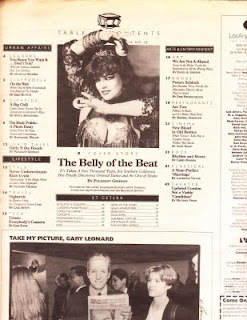
THE BELLY OF THE BEAT: THE LOS ANGELES BELLY DANCE SCENE, CIRCA 1994


My, how time flies! Sometimes I cannot believe I have been belly dancing- and writing about belly dancing- for nearly two decades. In my Royal Archives ( also known as the dusty jumble of boxes on the shelves above my costume closet ) I recently unearthed the following story, The Belly of The Beat, which I wrote under my given name, Pleasant Gehman, for the April 22, 1994 edition of The Los Angeles Reader, a large weekly newspaper I worked for extensively in the early Nineties. At the time I wrote the story, I had been dancing professionally for three years, and had absolutely no idea that fifteen years later, I would not only still be belly dancing, but performing and teaching internationally!

Needless to say, much has changed in the international world of belly dance since then... to begin with, back in those days, there was no Internet, no Belly Dance Super Stars, very few competitions and dance festivals, and it was difficult to buy costumes from Egypt and Turkey- many dancers made their own. We used cassettes and VHS tapes, not iPods and DVD's, and so on. Even so, the dance scene in Southern California was then-and continues to be- a hotbed of Oriental Dance. Many of the names you will see in the story- Sahra C. Kent, Fahtiem, Angelika Nemeth, Mesmera, Tonya and Atlantis and many others- are still quite active performing, teaching, writing about our beloved dance. I hope you enjoy this walk down memory lane- published here as it exactly as it appeared in the LA Reader in 1994.

* * * * * * * * * * *

The lighting is dim and reddish, the air heavy with smoke, and all that matters to the crowd, which is getting a little feisty behind tables heaped with an orgy of food and wine, is the drum. The drum, and, of course, the girl dancing to it, being led by it.

Jaqueline Eusanio is a blur of gold and black sparkles, cascade of russet, waist-length hair, a glimpse of thigh. She twists and turns slowly. Her eyes are closed, and the look on her face is distant and trance-like. She moves parts of her body most people don’t even know exist. Then suddenly, there it is—louder and more insistent this time— the drum, the drum, the drum. She starts spinning and finally, in perfect time with the beat, collapses to the floor in a spine-snapping backbend, perfectly executed. As the music swells up once again, a man in a suit steps forth and solemnly rains a thick wad of cash onto her, bill by bill, to the wild cheers of the cheers of the onlookers.

It sounds like a scene from a James Bond movie, but it’s Los Angeles—Burbank, actually—1994, and it’s just another Wednesday night at The Middle East Connection, a tiny hole-in-the-wall that transforms itself once a week onto a haven for dining and entertainment, Middle Eastern-style. That, of course, means belly dancing, which is very much alive and well these days, especially in Los Angeles, though many people aren’t aware of it. In fact, most people know very little about belly dancing, viewing it as a carnival sideshow attraction or some left-over fad from the Seventies. This couldn’t be further from the truth. The movements, correctly known as Oriental dance, have been around for thousands of years, and were performed in various styles and combinations all over North Africa and the Middle East.

One of the oldest dances on earth, it’s origins are cloudy. Some believe it represented fertility rights and was connected to pre-Islamic Goddess worship. Others claim the dance originated in India, with Gypsies, and was spread through out the Orient in their travels and migrations. It’s easy to follow the “Gypsy Trail,” as scholars call it, through Afghanistan and Persia, on into Turkey, where there was a split with one branch of Gypsies trekking through North Africa and the other meandering toward Eastern Europe. Even in modern Egypt, the term for dancers in rural villages is ghaziya, which is singular for ghawazee, meaning “invader” or “outsider.”

The original ghawazee were not of Egyptian origin. Egypt, however, has been a Mecca for Oriental dance for centuries. The women’s solo dance in it’s Egyptian social form is known as raks al-beledy (dance of the people) and is still practiced today, handed down from generation from generation. When it was refined by professionals whether they were courtesans or performers, it took on a slightly different aspect: the movements became more complex and less folkloric, and were tempered with nuances from other countries. This hybrid became known in Arabic as raqs al sharqi, ”dance of the East”- hence “Oriental dance” and was observed by the many travelers, writers, and painters who went abroad during the 19th century. The movements, especially of the hips and abdomen, had never been seen by westerners and caused a sensation.

Eventually, word of the amazing Oriental dancing girls spread to the West and the demand to see them grew. At the Chicago World’s Fair in 1893, Oriental dance made its American debut on the Midway Plaisance. Of the entire Midway, which featured exhibits from Japan, Germany, Holland, Italy, and Ireland among other countries, the attractions that drew the largest crowds were those with the famous dancing girls-The Turkish, Tunisian, Algerian, and, of course Egyptian. “Little Egypt,” as the most famous dancer was known, not only attracted huge crowds but scandalized the Victorian rubes to no end. To their uneducated eyes, her movements, considered highly skilled and artistic in the Orient, were obscene. Thus began a hundred years of misconceptions and bad press, which were only heightened by the late-Seventies belly-dance boom, in which enthusiastic but misinformed house wives donned veils and set out to turn their husbands into “sultans.”

“Ninety percent of Americans don’t know what it means, belly dance,” says Ben Mahmoud, owner of Moun of Tunis of Restaurant in Hollywood, where belly dancing is featured nightly. “It is like speaking out, like a communication, something in North Africa that you grew up with. It’s in your blood. Belly dancing is not stripping. It’s a language between the dancer and the audience.”

“People are finally becoming aware of the dance in a cultural way; it’s becoming less of a novelty and more mainstream.” says Feiruz Aram, a well- known Long Beach dancer who has worked through out the United States (as well as in Cairo) and has been teaching for more than fifteen years.

“With World Beat music getting so popular, Walt Disney’s Aladdin, and even Prince featuring belly dancers, it leads me to believe that Oriental dance will be intergrated into other dance forms.”

That concept worries some purists, who frown upon “fusion” of dance form and musical styles, but Michelle Forner, who regularly dances at Dar Margreb Restaurant in Hollywood and has a degree in dance ethnology from UCLA, disagrees.
“How can you keep something like this pure?” she asks. “It’s gone through so many changes, it’s hard to define. It’s not like ballet, where there are certain rigid steps.”

“There is no standardization,” says Zahra Zuhair, a petite grey-eyed woman who has been dancing for more than 16 years. “We’re still suffering from the Seventies, when people would just put on a costume and jump around, but these days there are a lot of good things going on. We have a very high caliber of dancers here in L.A… but anything can look strange when it’s taken out of cultural context.”

The culture "thing" is a big barrier- but not insurmountable. Anaheed, the vivacious dancer who runs the Wednesday program at the Middle East Connection, traces five generations of Oriental dancers in Los Angeles.

“The first was in the Forties and Fifties, when women came over or were brought over from the Middle East.”,she says.
“Then there was the second generation-well known dancers who learned from those women, and became teachers themselves, Jamila Salimpour, Marta Schill, Diane Webber, Aisha Ali. The third generation is people like me who learned from the second. The fourth generation is dancers who never experienced the club-scene here… it was huge. There were lots of clubs, like The Fez, Coco’s International, Omar Kayyan, Ali Babas-they all had old-style bands with live musicians-violin, oud, [a sort of oriental guitar], dumbek [drum]. The fifth generation is just now beginning to get their first dance jobs.”

The club scene fizzled in late Eighties Los Angeles for a variety of reasons, one being the economy: people were no longer willing to spend a lot of money on live entertainment.

“ The Gulf War really had an effect,” says Marta Schill, one of the founders of The Middle Eastern Culture and Dance Association (MECDA), which is a special-interest group for dancers but began in the late seventies as a union for women who worked in the clubs-The Middle Eastern Cabaret Dancers Alliance.

“In the late seventies and early eighties, there were over thirty-eight clubs in the area, and a lot of money was coming in from the Middle East,” Schill says. “The hostages and the Gulf War were the end of that, though. Some clubs went out of business over night.”

“There’s been resurgence, though, definitely,” says Aisha Ali, a respected dancer, teacher and choreographer whose field recordings of music from Northern Africa are now in their tenth printing.

“Dancers are learning much more now, and getting away from the self-styled and more into the entire culture. It’s not so much only in nightclubs and restaurants; people are looking into the dance for research and even for fitness.”

Angelika Nemeth, Orange Coast College’s Middle Eastern dance doyenne, suggests total immersion. “For the serious dancer, you have to go to Cairo, travel through the Middle East--- take classes, broaden your horizon. It’s not all nightclubs.”
Shareen El Safy publishes Habibi, which, along with Arabesque, is the leading Oriental dance trade paper, and features scholarly articles alongside costume hints and ads for dance workshops, costume swap meets, reviews of music, and performance videos. A veteran dancer and instructor, El Safy has traveled extensively and conducted workshops and tours of Egypt for years.

“When you travel a lot, you can tell Los Angeles is different,” she says. “There’s more of a Hollywood, show-biz influence here…the seven-part dance routine, use of a veil, that look of glitz and glamour. But there are also many professional dancers in LA, so there’s a really high level of skill. I think we’re going to be moving out of the clubs soon and into more concert-level productions.”

Still, the nightclub or Middle Eastern restaurant is the main place of employment for most belly dancers. Although clubs with live bands may not be as prolific as in years past, Oriental dancers still have many venues from which to choose, encompassing Greek, Persian, Turkish, Armenian, Moroccan, Tunisian, Lebanese, and Egyptian. Aside from Dar Magreb, Moun Of Tunis and The Middle East Connection, there are Darband, Marrakech, The Plaka, Burger Continental, Katoubia, Al Amir, The Athenian Gardens, Port of Athens, Byblos, Colbeh, Aladdin, Corfu Island, The Athenian, and many other venues featuring Oriental dance around town.

“These days, you’ve got to be versatile,” Anaheed says. “You’ve got to be able to dance to Greek or Persian music, which is different from Arabic. If you’re dancing to a tape, you have to make it look as exciting as though it was live. If it’s live, the drummer could be playing with you, making you look bad. You’re not under contract, you work week-to-week. There’s no insurance, and the tips are split. You have to decide that you’re willing to put up with all of it in order to perform your art.”

Not to mention the long hours waiting in dressing rooms that are usually supply closets or offices, inhaling cigarette smoke, dealing with overenthusiastic patrons who think it’s correct etiquette to grab at you or tip you with money held in their teeth…and, of course, the inevitable drunk who wants to see you roll a quarter on your belly. (Yes, it can be done by almost anyone who can perform a stomach undulation, but most dancers relegate that sort of performance to the “circus trick” category.)

“And then there’s the irony,” says Shahira, 1993 winner of the Egyptian Category of the Southern California International Belly Dancer of The Universe Competition, “That you don’t know the language—you have to be able to compete with Arabic girls who know what all the words mean and sing along while they dance, which audiences love.”

Noura, a Syrian native who lives in Los Angeles and works at the elegant Al Andalus in Studio City, has the advantage of being fluent in Arabic and English, but is just as cognizant of the competition. “In my country, or in Egypt, it is absolutely different,” she says, “The audience appreciates the dancer much more. Also, the club makes contracts with her. Here, there are lots of dancers, and some of them are kind who go see somebody dance, and then they think, ‘Hmm…I think I’ll take her job.’ You know?”

“There are lots of opportunities to dance here, though,” says Melissa Berger, a dancer and actress who recently appeared belly dancing in an episode of Brisco County, Jr. along with Jacqueline Eusanio and Atlantis. Television and movies have provided work for dancers like Veena Badasha, Fahtiem (who is a ringer for Ann Jillian, and a proficient Oriental dancer), Europa, Anaheed, Mesmera, and Michelle Forner. But the work isn’t steady—club and restaurant gigs are.

“This is how I make my living—performing and teaching.” says Fahtiem, who also heads the troupe Sultan’s Delights. “I don’t ‘do’ anything else, it’s not a hobby.”

Adds Forner: “I dance for tips—we all do. But there’s a line I will draw, like when some man is trying to grab me.”

“You know, most people who see Oriental dance see it as a beautiful art form, but there are some people for whom the stereotype still exists—or who are misinformed,” says Zahra Zuhair.

“Western audiences don’t know any better, because sometimes the dance is taken so far out of context, and there’s constant bad press focusing on it being so sexy. It’s sensuous, yes, but never blatant. I mean, this is a part of a culture. There’s a dancer at every wedding—Arab women learn this as children!”

“Unfortunately, a lot of places don’t afford the dancer an appropriate way to express herself,” says Eusanio, who is working on her dance degree at Pierce College.

“Oriental dance is a unique feminine expression, because no dancer will ever dance like any other—but it’s serious! You have to have a passion for it, be devoted to it—if you aren’t, then you shouldn’t be doing it, because it needs to taken up to the next level.”

Fahtiem agrees. “The general public really needs to be educated,” she says in a soft voice. “Most of the people I dance for are American, and they’re shocked. They’ll say, ‘My gosh—that’s really artistic!’—my feeling is that we need to transmit that this is an art, even in little ways, like belly-grams. I did one at an Acapulco [restaurant] the other day, for a dentist at lunchtime…I mean, these are people who never would’ve gone to a Middle Eastern club. To them, you’re representing the whole genre, and you have to do it with dignity and show them you have skills, and that you’re a professional—and a lady.”

At Orange Coast College, Nemeth teaches nuances of Arab culture along with the dance steps, and has presented a series of folkloric dance concerts to the students and faculty, most of whom would never have made it on their own to the clubs and restaurants that feature belly dancing. Aside from raks al sharqui and beledi, there are many traditional dances— raqs shamadan, which involves balancing a large candelabra on the head (an Egyptian wedding tradition), Turkish scimitar (a curved sword) balancing, the used of zills, (Turkish for finger-cymbals; in Arabic they’re called sagat) canes (raks assaya), handkerchiefs, and Moroccan tray dancing, which also involved balancing the object on the head, and is traditionally done by men.

Yes, indeed, there are male belly dancers. In the tradition of ballet, many of them are excellent teachers and choreographers, as well. Though dance is a daily part of life in most North African or Middle Eastern countries, and many dances are the sole property of men, Western culture has traditionally emasculated most dance forms unless they are a display of athletic prowess.

“It’s dicey here, you have to get beyond the Chippendale’s mentality,” wearily laughs Zain Abd-Al Malik. Well over six feet tall, Abd-Al Malik is even more imposing when his heavy brass tray is balanced on his head. A Los Feliz resident, he’s danced all over the West Coast, and even in Morocco and Saudi Arabia, where he lived in a royal palace for nearly a year. An article on that experience, “Bel Air, Beirut, And Beyond” was just published in Habibi, and he will be on the cover of Arabesque this spring. Although Abd-Al Malik is concentrating on scholarly research and teaching these days, he has a lot to say about performing.

“To American audiences, it’s hard to interpret the dance in what they perceive as a masculine way,” he says, exhaling his decidedly masculine Marlboro.

“The basic movements are usually seen as ‘feminine’ in Western terms, but what I’m doing is not a women’s dance.”

Kamaal (Mr. America of the Belly Dance 1986 and 1992) is a Bay Area transplant who does everything from folklore to cabaret, and deals with the same problems as Abd-Al Malik.
“You have to really come across heavy ethnic, or audiences tend to freak,” he says. “In the Bay Area, if you don’t have a male dancer, the club’s not complete, but down here, it’s different.”

“There really are more men in the business than you would think,” Abd-Al Malik says, citing famous dancers like Ibrahim “Bobby” Farrah (who also is the publisher of Arabesuque), Mahmoud Reda, and Mohammed Khalil. “Women are more in the spotlight, but the men are the costumers, the choreographers.”

Kamaal maintains both traditions—when he’s not teaching or performing, he operates a costume business, Harem Treasures.

There are not nearly as many male dancers, but they are not always in demand, either, so “day jobs” are a necessity. As odd as some audiences find the male performers, women sometimes get very uncomfortable watching other women dancing, because of the sexuality perceived in the basic motions of the dance. Most women, thought, have a very positive attitude when presented with an Oriental dancer, one that’s far more enlightened than their male companions. And some, at the first sight of dance, become hooked immediately.

“The very first time I took a class,” remembers Anaheed, “I went nuts! I was thinking, “here is the method of self-expression I’ve been looking for all my life.’ I’m not a writer, I’m not an artist—but I can talk with my body.”

“When I’m dancing for women, some women will actually have a physical reaction,” says Laurie Rose, a.k.a. Mesmera. Known for her specialty snake dance (with live boas that she keeps in her house), Rose is heavily into the feminine energy inside of the spectrum.

“Those women will have something in their body that snaps, and as they’re watching me, their body is going. ‘I WANT THAT!’ You can see the light bulbs going off in their heads—‘I could be enjoying this myself!’ They’re realizing that their back could be arching like that, their hips could be working like that. The body language of the belly dance says more than words ever say—I’m alive and creative and in touch with my body in a spiritual, joyful way. My hope is that I ignite those feelings in women…it helps empower them.”

Rose’s Silver Lake house—also her studio—is an ancient Spanish stucco affair, full of drums and African masks and incense and cassettes. There are piles of veils in the corner of the large, airy room she teaches in, and Orientalia everywhere. She talks about her theories on the dance as she putters around, dressed for class in a leotard and coin-belt, and removes a frozen white rat from the freezer.

“For the snakes!” she explains cheerily, dropping if off in the reptile room to defrost. Rose teaches about six classes a week and conducts seminars, as well. She’s been working at Dar Magreb for more than ten years and has released two dance videos. One of the dances’ most important features, she believes, is spontaneous creation. The women who attend her classes also sometimes come to the dance and drum circles she holds in various parks, where self-expression rules. Her latest venture is mixing Arabic dance with African, which she explores in her troupe, Mesmerasha.

Across town in Studio City, Zahra Zuhair’s Saturday morning classes are the polar opposite. Most of her students are working dancers, and it shows in the curriculum—mostly technique drills and choreographies done to popular songs one is likely to hear in Arabic clubs. The classes are tough and sweaty, and no one talks, focusing instead on the work at hand. Afterwards, however, it’s hard to get a word in edgewise with all the gossip about costumes, jobs, and auditions.

Both Melody and Jodhi work at Moun Of Tunis, and take classes regularly from Zuhair and other teachers. “When I first started out,” says Jodhi, who has been dancing for almost six years, “I didn’t know where it was going to take me—but I just love it.”

“It’s completely become the focus of my life,” Melody says. “I’m obsessed.” The complete absorption and, yes, obsession, is what holds troupes like Annaheed’s Perfumes of Araby together for years—decades, in some cases. Perfumes was started in the mid-sixties by Dianne Webber and is the oldest continuously performing troupe on the West Coast. Fahteim runs the troupe Sultan’s Delights, which has been together for more than ten years, and Jorjanna’s Troupe Mosaic (which also sponsors open classes every summer) has been around for almost thirteen years.

The long hours of rehearsing always pay off, and at Tonya and Atlantis’s Southern California International Belly Dancer of The Universe Competition, held every February, it’s readily apparent who did their homework. The contest, which the mother-and-daughter team has been running for four years, features cash prizes, a coveted title, and the chance to appear in front of your contemporaries and strut your stuff. In addition, the weekend-long event also includes workshops from visiting teachers, vendors, and a chance to network, culminating in a gala show at the end of the evening, after the judging. The competition itself features different categories for troupes, duos, Egyptian-style, and “The Complete Belly Dancer” –one who is able to perform under any circumstances.

This year’s contest took place at a spacious new Elks Lodge in Long Beach. We knew we were getting close when we spotted a silver Volvo with the license plate “SHARQI.” Inside, even at 10 a.m., the competition was in full swing. The halls were dotted with dancers in caftans covering their costumes. The hall itself was packed with vendors’ tables, heaped with glittering Egyptian and Turkish costumes, veils, cassettes, drums, cymbals, headpieces, bracelets, and the like. Racks of used costumes were for sale, and everywhere you looked, women were trying on fringed belts, swaying and undulating in time to the Arabic music pouring from the loudspeakers. Old friends were greeting each other Arab-style with a hug and double-cheeked kisses, and the clatter of zills and coin-laden costumes was everywhere.

The contest is a constant parade of all styles, variations, and hybrids of Oriental dance, presented by a mélange of performers, from consummate professionals to students who are competing just for a lark. To win a title ensures cachet in the form of better bookings, parties, and invitations to conduct workshops.

Watching the parade of dancers in sparkly costumes, Cookie Hamidzadeh of Turquoise International Belly Dance Supply House (co-owned with her husband, Ali) discuss the future of the dance.

“I think we’re going to swing back to the more earthy and ethnic,” she says, even as she arranges her table, full of glitzy Madame Abla costumes. The last word in up-to-the-minute Egyptian dance couture, the must-have Madame Abla stage duds run from about $600 to more than $1,000, depending on the construction and how much fringe—all hand-beaded-drips off the garment.

The Hamidzadehs have done a booming business since the early Seventies, when Ali founded the company with his own brand of finger cymbals. Now, they stock everything from the pricey, coveted Madame Ablas to hand-beaded fringe by-the-meter, to scarves, wristlets, jewelry, dancing canes, and candelabra . In addition, they sponsor dance-study tours to Egypt, and bring in well-known dancers for workshops. Their mailing list numbers in the thousands, and they are always up on the latest dance-oriented news and juicy gossip.

“I think that we’re about to experience another boom,” Cookie says. “In the seventies, Ali was selling about two thousand sets of cymbals a month. Now, it’s more like two or three hundred. But it’s growing again. People from all walks of life are getting interested for different reasons—as fitness, a women’s thing… remember, it’s going to swing back to ethnic!”

The swing may have already begun. A few groups in the Los Angeles area have started to experiment with more rootsy, ethnic forms of the dance. Europa is San Francisco émigré who did time in the Bay Area Middle Eastern club scene. When she moved south in the mid-eighties to pursue an acting career, she also wanted to return to her dance origins. A student of the renowned Jamila Salimpour, she’d danced in Salimpour’s influential Bal Anat troupe, which blended the more raw, drum-oriented forms of dance with an exotic and extravagant form of “tribal” dress that mixed Bedouin, Algerian Ouled Nail, and Turkish influences—lots sashes, antique coins, and facial tattoos. Eschewing the glitz, Europa founded her own troupe, Raks Majnoun (“crazy dance”), in 1991, with a group of like-minded musicians, including Daoud Coleman, a well-known drummer, cellist, and nai (flute) player who’d previously worked with Prince. The concept of the group was “California Arab Industrial”.

While one woman danced, the other dancers would play drums, cymbals or rek (tambourine) to tapes that Coleman had prerecorded, while he accompanied live on cello and Arabic vocals. Playing in non-traditional local venues like Sin-A-Matic, The Pik-Me-Up, and Club Fuck, Raks Majnoun may well have been he only troupe ever to have used a cello hooked up to a fuzz-distortion box, but it also brought Oriental dance to people who never would have experienced it otherwise. “What really bummed me out the most was the rise of the synthesizer in the eighties,” Europa says. “People can’t play the oud anymore—it’s going to be a lost art.”

David Hermon’s Experiencia Fantastica is a group of musicians who started playing together for fun, and whose ranks have swelled to include dancers, jamming friends, and audience members, who are heartily encouraged to participate. Hermon was a photographer and rock musician who became interested in Middle Eastern music just after his father died.

“I underwent a personal transformation,” he remembers. “One day, I was in Hollywood, the next day I was in a souk in Israel. I bought a drum…”

After returning to the States, and noodling around on the dumbek himself, he attended Middle Eastern dance camp in Mendocino. Since then, he’s been immersed in the scene. He dances with Aisha Ali’s company occasionally, and at Renaissance Faires, but most of his energy goes into Experiencia Fantastica. Hermon works with Turkish virtuosos Salah Aleddin, Joshgun Tamir (who also plays with Aman Folk Ensemble), and Abdurrahman Tanrieogen, as well as an ever-changing ensemble of other players, including the beautiful Azam, who knocks the audience out with her playing of the santour, a stringed, Persian auto harp-like instrument.

The group began playing at the Grassy Knoll coffee shop in Silver Lake and now occupies Nova Express café in the Fairfax district every other Saturday night. The crowd usually spills out onto the sidewalk, the audiences sing, clap, and play along with the rhythm toys the band provides, and the evening always features a series of guest belly dancers, who come from local troupes, the Renaissance Faire, and nearby restaurants to dance to the live music. The mood is exultant, and the nights are getting so crowded that Hermon says the entire event will soon relocate to a larger venue, West Hollywood’s Luna Park. “They’re playing and dancing for the pure love of it,” Aisha Ali says. “It’s great for them to develop as musicians, and it’s great to watch.”

Most dancers, working or not, do dance for the love of it. But in the back of everyone’s mind is the ultimate fantasy: recognition, fame, fortune … and a chance to work in the Middle East, Egypt, in particular. To dance in Egypt, is evuivalent of racing in the Indy 500 or competing in The Olympics.

Southern California’s Carolee Kent has achieved that goal; for the past five years, as Sahra, she has danced at Cairo’s posh Le Meridien Hotel. In Egypt, she has enjoyed the recognition and prestige of being a top belly dancer (which is akin to being a movie star or well-known athlete), but back in the States, the myth of Sahra has grown to almost legendary proportions. Her performance videos sell like hotcakes, and on her yearly excursions back to Southern California (timed to coincide with Ramadan, The Muslim religious observation that is roughly equivalent to Lent, in that there is fasting and most forms of entertainment are given up), her workshops and shows sell out almost immediately.

Sahra’s engagement began almost accidentally. She was in Cairo, studying with the well- known choreographer Farida Fahmy, who knew it was Sahra’s dream to perform in Egypt. As a favor to Fahmy through an agent pal, Sahra got to perform one night at Le Meridien, as part of a series of audieitons they were holding. She got the job- and had to start immediately. Hardly believeing it was possible, Sahra took the engagement and began working right away without even a chance to return home to collect her possessions.

“It was so strange at first, realizing that I was actually going to be living in Cairo—things were so different,” Sahra says. “Everything was a culture shock, and the longer I stayed, the more things seemed different—not like when you’re there for a vacation. The language barrier was tough, but now I’m to the point where I can communicate with the musicians and people on the street.
“Every time, I come back to Southern California, things seem so different. It seems that people here could become more serious… more rehearsals and discipline. But there are a lot of great dancers here, real artists, and it’s almost time that I came home. I think the next year in Egypt may be my last.”

Sahraa wants to finish her master thesis, as well as to do a large-scale choreographed Oriental video, much like an old movie. She says the most instructive part of her time in Egypt has been viewing her audiences and their observations, as well as seeing the dance in its natural context.

Anticipation for Sah’ra’s show at Al Andalus in Studio City—one of only two Southern California appearances—was running high. The eagerness was palpable inside the club, and the audience was made up of a veritable Who’s Who of the local Middle Eastern dance scene. Zahra Zuhair was there, swathed in white mink, at a front table. Zain Abd-Al Malik was there, sitting with Hallah, a seventeen-year dance veteran whose costume designs are currently all the rage. One table was headed by Shahira, Michelle Forner, and Naima; Aisha Ali was there with a group of her students; Anaheed, Yusef, and Odette of The Middle East Connection were in attendance, as was Dr. Samy Farag, a noted composer; the well-respected Jacqueline Lombard, Tahia, and the show’s producer, Linda Tesar.

“ I can’t wait until she comes on,” says Melody, with the urgency of a six-year-old about to enter Disneyland. Suddenly, the house band burst into the classic strains of “M’Shaal” and Sahra appeared in a whirl of red and gold sequined veil. The audience, as a unit, leaned forward to take in her every movement. Her face was serene and her energy seemed ethereal and quietly strong. The rich subtlety of her movements was effortless, and the classic hand and arm gestures were almost rgeal in their beauty. As she shifted into the slow taqsim (the improvisational portion of the dance) the club was so quiet you could hear paillette sequins rustling against one another. Around the room people were beaming with pleasure, watching her unbelievably precise shimmies and layered undulations. This was beyond “local gal makes good,” beyond seeing a peer that you could judge or compare yourself to. Sahra, in her performance, seemed to embody the whole essence of the dance, every nuance, every variation. This was grace and artistry and dignity, this was mystery and sensuality, the movements that have lasted through the ages and still mean something. This was what it’s all about.


PHOTOS: JEFFOTO
LA READER COVER FEATURING JACQUELINE EUSANIO AND LA READER CONTENTS PAGE FEATURING PRINCESS FARHANA

Tuesday, August 25, 2009

INTO THE WILD


One of my favorite things about being a professional dancer is that my jobs bring me all over the world. I not only get to earn my living doing something I love, but I also have the opportunity to visit exotic locales meet a huge number of creative, talented, dynamic, intelligent and FUN women, who usually turn into great friends. My recent trip to Alaska to teach and perform, which I had been looking forward to for over a year, was a stellar example of why I love my life. It exceeded anything in my wildest dreams, from the shows and the workshops to what I did in my off time. My sponsors Shadiyah in Juneau and Kamala in Anchorage went above and beyond in the events they organized and their hospitality. There is a very active dance scene up there and the women are dedicated to continuing their dance educations, as well as putting on a number of events open to the communities. My visit was preceded by an Alaskan tour by Canadian dancer Hadia, and everyone was already buzzing about Eva Cernik’s up-coming dates.

I even had a student fly in to Anchorage for private lessons. At first, I thought this was odd or that she must have been rich, but locals assured me that not only are visits from touring dancers so rare up there that many dancers learn solely from DVD’s, but also that some towns in Alaska are so remote they can only be accessed from ferry boats or planes.

Across the bottom of the license plates in Alaska, it reads “The Last Frontier” but Alaska was so different than “The Lower 48” that I often thought I was in a different country! To begin with, the whole place looked like a picture postcard. There were panoramic views with snow-capped mountains, vast expanses of silvery ocean bays, evergreen woods with fairytale sized mushrooms, blooming wildflowers, awe-inspiring cloud formations, and abundant wildlife. The scenery was so stunning, I joked that it seemed like there were glaciers just “laying around” everywhere you turned! The sun stayed bright until almost midnight, which was thrilling and exotic-if a little disorienting- to a California girl like me.

Then there was the “every day” stuff that was so different, too. I saw more taxidermy (in stores, restaurants, public buildings and private homes) than I have ever seen in my entire life. Every park or hiking trail had signs warning of bears, elk, or wolves. There were dog sled trucks and pick-ups with gun-racks or kayaks bound to the roof parked at convenience marts; the parking spaces had electric plug-ins for engine heaters- a necessary item in a place where winter temperatures can reach forty below zero.

It seemed as though everybody was wearing camouflage or polar fleece, and backpacks. In the airports going to and from Alaska, the TSA security checks included special “survival weapons” checks (yeah, it seemed like I was practically the only person not packing a gun) and instead of the usual items discarded in the security line, like bottled water or hand lotion, there were items like buck knives and bear spray left behind.

I visited Juneau first, and began a whirlwind with my sponsor Shadiyah, who is a criminal investigator, a pilot, a mom and a belly dancer. From the moment she picked me up, things never stopped. On the way home from the airport, she took me to see Mendenhall Glacier, which looked like a movie backdrop. Imagine turquoise blue icebergs floating around in a polar lake- it was stunning. We began my first morning in Alaska with a “typical” domestic chore: picking a 2 ½ inch porcupine quill out of her Irish Setter’s muzzle with a pliers…before we’d even had coffee! Courtesy of dancer Kat, we went whale watching on Auke Bay, with many belly dancers. The trip was gorgeous on calm seas, and we saw pods of Orca and Gray Humpback whales. The mature whales are roughly 30-60 feet long- like the size of three or four Cadillac’s laid end-to-end, or about three quarters of the size of the boat we were onboard! We saw a “bubble net feed” (a pod of whales diving in succession to churn up schools of fish to eat) and three of the magnificent beasts breeched the surface, spinning and turning in the air about 40 feet from our boat-deck. I was screaming in delight and wonder the whole time, and so were the other whale-watchers. Being a greenhorn, I thought this was normal for a whale-watching expedition, but t my fellow passengers, the crew and the captain assured me it was not. After that, it was time for an afternoon radio interview to promote our show that evening.

The show itself was held at The Rendezvous, a club in downtown Juneau and featured all sorts of entertainment. Aside from my two sets, local belly dancers performed, including Shadiyah herself, Majida (a massage therapist who worked her wonders on me the next day) and the Tribal troupe Patshiva, who were all related: sisters, daughters and mothers-in-law! How wonderful to see an extended family that has been dancing together for years. The band Noodle Of Doum played a couple of sets of Arabic/Pirate/ ethnic stuff infused with a good deal of comedy and showmanship: at one point they did a number called “Redneck Beledy” which featured Majida dancing in a plaid woodsman’s top tied up at the waist, balancing a rifle on her head! The stage manager also performed. A Juneau native who’d been living in Seattle, he performs under the name of The Luminous Pariah. "Lumi", as he is known, danced twice: once as an Alaskan fisherman in a number called “The Biggest Catch” and once in drag in an incredible Scarlett O’Hara-type hoopskirt made entirely of recycled materials (like plastic dry-cleaning bags) with a corset made entirely of duct-tape.

Workshops took place the whole next day at the creative hotbed of the city, The Juneau Arts And Cultural Center, where I taught four classes in total.The next day, Kathleen, who has been a leading proponent of the Juneau belly dance scene for years and leads the troupe Daughters Of The Moon, held a hafla at her beautifully appointed dance studio, followed by a potluck feast. The following day, Kathleen graciously allowed me to give private classes in stage make-up and sword technique at her studio, and also let us peruse her collection of hand-made costumes and belly dance scrapbooks.

Shadiyah and I left for Anchorage the next morning. Though our plane was delayed for a few hours, it didn’t matter once we touched down in Anchorage: our hostesses Kamala Stiner and Vivavoom Brrr-lesque met us at the airport in a white stretch Hummer limo, with a freshly-popped bottle of French champagne! Shadiyah and I settled into our cozy wood cabin, where Chilikoot Charlie’s put us up, the club we were appearing the next three nights. That evening, Kamala and her husband Frank took us up to Arctic Valley to watch the Perseids Meteor Shower. Though we arrived well after 11pm, we had to wait over an hour until it was dark enough to see the shooting stars, but the delay was worth it.

The next day was consumed with tech-checks for our show, “Through The Veil” plus the opening night of the show itself. Kamala and Frank have run Vivavoom Brrr-Lesque together for years, and though the troupe usually performs at Anchorage’s Snowgoose Theater, the Chilikoot Charlie’s shows were the opening of their fifth season. The troupe consists of a live jazz band, comedians, dancers and circus performers, plus special guests. Many local belly dancers participated, including Gypsy Underground Tribal duo, poi-spinning belly dance by Kimber, and an AmCab drum solo by Corliss.

A nurse by day and a dancer by night, Kamala runs a tight ship with a sense of ease and fun and the troupe has a large following in Anchorage, a city with a thriving entertainment scene: there are diverse communities of belly dancers, circus performers, alternative musicians emerging artists and burlesque dancers. The shows, held in the club’s baroque “Russian Room” theater, were a resounding success. The club also graciously lended day-time space on all three days for my workshops, which included belly dance arms, abdominal technique, fan dancing, Oriental combinations and burlesque.

On my last day in Alaska, Kamala and Frank took us on a sightseeing trip down the coast to the Alaskan Wildlife Conservancy, where we saw bear, moose, caribou, a bald eagle, and elk, buffalo and yaks. The Conservancy takes care of orphaned wild animals and endangered species. We saw the Ghost Forest, another glacier, and capped it all off with a gourmet organic dinner in the resort town of Girdwood.
Arriving the next night in LA, I knew I was definitely home: nobody in the whole airport had on Polar Fleece… I also spotted a thirty-something woman with pink hair and Anime clothes clutching an over-sized stuffed toy, and then I literally bumped into Keanu Reeves at the baggage claim.

Thanks to all the wonderful dancers I met in Alaska, and an extra special shout-out to Deb at The Rendezvous and Doran at Koots... I hope I can return soon!

Pix: Gastineau Channel from Mt. Roberts, Majida performing "Redneck Beledy", the cast of Vivavoom Brrr-lesque in The Russian Room

Tuesday, August 4, 2009

YOU GIVE GREAT FACE: DANCE MAKE-UP FOR STAGE AND PHOTOS


As a performing dancer of any genre, you want your face to be not only beautiful and finished, but also expressive. You will want to look fabulous- with pretty doe eyes, luscious lips and have your best features maximized. In general, belly dance make-up should exotic and mysterious, but not garish- there’s a fine line here that is easy to cross. For work where you will be seen up close, such as private parties or outdoors in the daytime, like at a dance festival, you’ll definitely need more make-up than you would wear on the street. This can be as uncomplicated as rimming your eyes with liner or powder shadow a little darker and more heavily than usual, and using a brighter shade of lipstick. Of course, if you’re a major glamour-puss (like me!) you will also want to add a bindi or two, a medium-sized set of false eyelashes, and some body glitter.

However, if you are working on a large stage, or about to have professional photos done, wearing a little more eyeliner simply won’t cut it. The first thing you must remember about being onstage or in a photo studio is that the lights will wash out your features. You may have on a spectacular costume and be dancing beautifully, but without make-up (or with "every day" make-up) your face will appear almost blank. The basic look gone over here will enhance your features and also work well with dim lighting, the kind you may encounter while dancing in a restaurant or nightclub. For black and white photos you can really pile it on; with color photos you need a slightly more subtle approach. This look may seem heavy and almost clown-like up close, but on stage or under harsh studio lights, your face will look natural, yet intense, with your features accented.

For stage and studio work, you will definitely want to wear foundation make-up, or a combination powder/foundation, because it will make your complexion appear poreless and perfect. Sheer formulas are not good or strong enough to achieve this effect- you will need a very opaque, full-coverage type of foundation to get the desired effect. In general, you would select a foundation color by matching it as closely to your own skin tone as possible. Try foundation samples on the inside of your arm, this skin tone is very close to the color of your face. For stage work, many performers like to use a foundation that is a shade or two darker than their natural skin tone, because it makes their face appear brighter and more robust under the harsh stage lights. If you are unsure what color to pick, consult with a make-up artist at a department store cosmetics counter.

To apply your foundation, use a sponge edge or clean fingers to daub the make-up onto your face, and blend it well, making sure to extend the blending onto the sides of the cheeks, chin, and onto the neck, so you don’t have a discolored, de-markation line where the foundation ends and your natural skin tone begins. Press translucent or similarly toned powder onto your face to set the foundation, and wait a few minutes for it to set before applying any other make-up. Before applying eye make-up, a pro trick is to sprinkle a good amount of translucent powder or even baby powder on the cheeks, directly under the eyes.
This will catch any “migrating’ pigments from the eye shadow you are about to apply. When you are done with your maquillage, simply blow or brush away the excess powder for a flawless finish.

BASIC DANCE MAKE-UP FOR STAGE AND PHOTOS

#1) Cover entire eye area (lid and upper lid) with beige, white or ivory shadow.

#2) Lightly pencil in brows (with short, feathery strokes, not harsh lines) and extend outward and upwards.

#3) Accentuate the hollows at the inside corner of your eye with a light brown shadow. (This step may be eliminated if you have large eyes with big lids)


#4) Use dark brown shadow or gray in the crease of the eye, and, if you like, extend it in a sweeping wedge outwards and up at the outside corner for a cat-like slant.


#5) Smudge a "V" shape of black or dark grey shadow in outer corner of eye.


#6) Softly line under the eye in back or gray shadow. Dark blue also may be used; it makes whites of the eye appear whiter. Smudge shadow so the line is not harsh.

#7) Apply black mascara to top lashes. Brown might be ok for every day but black is much better for stage and photos. Instead of mascara, which will run if you sweat while dancing, you may wish to apply false eyelashes. Most professional dancers eschew mascara altogether and use faux lashes.

“ But wait!” I can hear your panicked cry, “I haven’t the foggiest notion of how to apply false eyelashes!”

Never fear! I was taught to apply false eyelashes by (who better?) a professional drag queen! After a simple demo, I mastered the art of faux-lash application and have never looked back. It’s easier than you might think, too.
The first things you will need to do are look at the lashes, and determine which is for the left eye, and which is for the right. Yes, eyelashes are made differently, with the smaller, shorter hairs meant for the inside corner of the eye. Next, trim the lash (at the inside end) to fit your eyes. Some of us have long, almond-shaped eyes; others have eyes that are slightly rounder in shape. False lashes are meant for everyone, so most are too long, on purpose length-wise.

After you’ve trimmed the lashes, apply a thin band of glue to the base of the false lash, and let it sit for at least 30 seconds, - more like a full minute or two, until glue is tacky. The brand of the glue, or the amount you put on the lash will determine how quickly it dries. My drag queen pal used to give me this sage advice:

“ Girl, you put the glue on your eyelash. Then you walk your ass into the kitchen, and pour yourself a nice cocktail. Wander over to your closet, open the door, and think about what stunning outfit you’re going to wear. Then you take a sip of that cocktail, and figure out what jewelry will go with your dress. …Then you take a few more sips of that cocktail, til it’s almost half gone. When you’re thinkin’ ‘bout finishing that cocktail…. And only THEN… you pick up your lash, and put it on! And, honey, repeat every step for the other side!

Cocktails or not- it was good advice. The main reason most gals have a problem with applying false eyelashes is that they try to stick the lashes on when thy are too wet, which can result in slippage, or worse- actually gluing your eyelids together!

I recommend "DUO" glue in clear/white, it’s my favorite because it holds well and is the least irritating of any brand I've used. Using clear glue, by the way, is better, because it dries invisibly. If you use the dark-toned glue, it can make mistakes look very obvious. When you are ready to apply the lash, sit it on your upper eye-lid, just above your natural lash-line. Press down lightly in the middle first, and then tap the lash down lightly towards inner and outer corners. Keep your eye closed for a moment, to let the glue take hold. And back to the rest of your make-up…

#8) Finish the eye by lining the top lid with liquid eyeliner, or smudge some black pencil over the lash-line. It will hide any visible glue. If you are using big, thick lashes, you won’t even need to do this.

#9) A nice touch is to apply pearly white or light silver shadow in the inside corners, just over the tear-ducts, to open the eyes.


#10) for more glamour in a live show, lightly sprinkle glitter just under brows, or apply with a finger or paint on with eyeliner sealer to make the entire area sparkly, being careful not to get any INTO your eye. Opt against the glitter if you are doing a photo session. On film it doesn’t appear sparkly, just grainy.

#11) Rhinestones or sequins may be glued onto outer corner of eye for a flashy fantasy effect. This looks great onstage, but in photos it may appear as a white blur that will look like a scratch on the negative, so it's not recommended for pictures. To glue the stones or sequins on, simply apply a tiny dot of lash glue to the back of the decoration and stick it on where you want it.

12) For bee-stung, "kissable" lips, apply lipstick and blot with a tissue, then draw an outline with pencil just over the lip-line on your lower lip, to make it appear fuller. A small dot of white or gold eye shadow in the center of the lower lip makes it look even fuller. On stage for a natural look, use, beige or pinkish- nude lipstick outlined with mauve, purple or brown liner. Up close, it will look weird, but it looks like plump, kissable lips from far away.


13) Contour just under cheekbones and jaw line with light brown shadow or blush, blend well. Apply a pinkish color on the "apples" of your cheeks for color, especially on stage. To find the “apple”, smile at yourself in the mirror. Start with a minimal amount of color, and build from there.


14) Powder your face to set make up, either with a puff or cotton ball, and you're good to go! Make sure you bring your make up bag along for touch ups.

15) Remember to take off ALL your make-up before going to sleep!


PHOTO BY DON SPIRO